Yoga is often pictured as a quiet, individual practice: one person, one mat, and one breath.
But yoga can also be shared.
When two people practise together, even a familiar posture becomes a new experience. You are no longer aware only of your own balance, breathing, and comfort. You must also notice another person—how they move, where they hesitate, when they need support, and when they need more space.
That is what makes yoga poses for two people so meaningful. They do not simply make yoga more entertaining. They can teach communication, patience, cooperation, and respect in a very practical way.
You can practise with your spouse, partner, friend, sibling, parent, or another yoga student. The word “couple” does not have to mean a romantic couple. It simply means two people agreeing to move, breathe, and learn together.
You also do not need to be exceptionally strong or flexible. Many couple yoga poses are simple, accessible, and close to the ground. The intention is not to recreate a flawless social-media photograph. The real practice is learning to remain aware of yourself while supporting another person.
In this guide, we will explore easy, intermediate, and advanced yoga poses for two people, along with modifications, partner communication prompts, safety precautions, and a complete beginner routine.
What Is Couple Yoga?
Couple yoga, commonly called partner yoga, is a form of practice in which two people perform postures together. Each person may provide balance, resistance, support, or gentle assistance to the other.
Some couples yoga poses are performed side by side, with both partners creating the same shape. In other postures, the partners face each other, sit back-to-back, or take different but complementary positions.
Partner yoga may include:
· Synchronised breathing
· Mirrored movements
· Assisted stretching
· Shared standing balances
· Strength-building postures
· Supported backbends
· Partner meditation
· Acro-inspired balances
A good partner practice is based on cooperation, not control. Your partner’s body is not a prop that you can pull, push, or position without permission. Each person remains responsible for communicating their own limits.
Partner Yoga and Acro Yoga: Are They the Same?
Partner yoga and acro yoga overlap, but they are not exactly the same.
Partner yoga is the broader practice. It can include gentle seated stretches, breathing exercises, standing poses, twists, relaxation, and meditation. Most easy couples yoga poses remain close to the floor and can be modified for different abilities.
Acro yoga usually includes three clearly defined roles:
· Base: The person maintaining the primary connection with the ground
· Flyer: The person being supported or lifted
· Spotter: The person helping both practitioners enter, hold, and exit safely
Acro yoga requires more specialised training because one person may be partially or completely lifted from the floor. Watching a video or looking at a photograph is not enough preparation for a complex lift.
If you are completely new to yoga, begin with grounded 2 person yoga poses. Build communication and body awareness before progressing towards flying positions.
Why Practise Yoga with Another Person?
Practising yoga with a partner changes the nature of the experience. You may enter the session expecting to work on your flexibility but discover that communication is the greater challenge.
Perhaps one partner moves too quickly. One may be afraid to say that a stretch is uncomfortable. The other may try so hard to help that they apply too much pressure.
These moments are not failures. They are part of the practice.
Physical Benefits of Couple Yoga Poses
1. Improved flexibility
A partner can provide stability during a stretch and help you explore a comfortable range of movement. However, the assistance must remain gentle. More pressure does not necessarily create a better or safer stretch.
2. Better balance
In postures such as Double Tree Pose and Partner Warrior III, both people receive immediate feedback from each other. If one person leans too heavily, both partners feel the effect.
3. Increased strength
Partner Boat Pose, Chair Pose, Plank variations, and acro-inspired poses engage the abdominal muscles, legs, shoulders, back, and arms.
Strength in partner yoga is not only the ability to hold another person. It is also the ability to control your own body without collapsing into your partner.
4. Greater body awareness
Because every movement influences someone else, you begin to notice where you place your weight, whether you are holding your breath, and how confidently you enter or leave a posture.
5. Improved coordination
Many yoga poses for couples require both people to bend, rise, rotate, or balance at the same time. This develops coordination that an individual practice may not demand in the same way.
Mental and Emotional Benefits
1. More conscious communication
Partner yoga encourages clear, direct language. “I am ready,” “Please reduce the pressure,” and “I need to come out” are small sentences, but learning to say them honestly can be valuable.
2. Stronger trust
Trust is not created by asking someone to perform the most difficult pose. It develops when each person listens and responds consistently.
If your partner says “stop” and you stop immediately, trust grows. If they feel unsteady and you remain calm, trust grows. It is built through small, respectful actions.
3. Reduced mental distraction
When another person depends on your attention, it becomes harder to think about unfinished work or your phone. You must be present with the posture, your breathing, and your partner.
4. Playfulness
Individual yoga can sometimes become overly serious. Partner yoga brings back curiosity and laughter. Losing balance gently, beginning again, and learning not to blame one another can make the practice more human.
5. Teamwork without competition
Partners may have very different bodies and abilities. One may be flexible but less stable; another may be strong but physically stiff. Couple yoga teaches you to work with these differences instead of ranking them.
Before You Begin: The Three-Word Communication System
Before trying any yoga poses for two people, agree on three verbal cues:
· Ready: Both partners feel prepared to begin or change the position.
· Pause: Stop moving but continue supporting the current position if it is safe.
· Out: Leave the posture immediately in the safest controlled manner.
“Out” should never require an explanation.
If either person uses it, both partners come out of the pose. You can discuss what happened afterwards.
This simple system prevents vague communication such as “Wait, maybe, I don’t know,” which can become dangerous during a balance or lift.
Essential Safety Guidelines
Partner yoga is not automatically safe because another person is supporting you. In some positions, your partner can unintentionally apply more force than you would apply to yourself.
Before practising:
· Use a firm, non-slip surface with enough clear space around you.
· Warm up before attempting deep stretches or weight-bearing poses.
· Remove watches, belts, jewellery, and other objects that may catch or scratch.
· Discuss existing injuries, pain, pregnancy, or movement restrictions beforehand.
· Never force your partner deeper into a stretch.
· Avoid pulling directly on the head, neck, wrists, knees, or lower back.
· Do not hold your breath to remain in a posture.
· Enter and exit slowly rather than dropping or releasing suddenly.
· Use a qualified instructor and spotter for lifted or inverted poses.
· Stop if either partner experiences sharp pain, dizziness, numbness, panic, breathlessness, or joint pressure.
Consult an appropriate medical professional or experienced yoga therapist if either person is pregnant, recovering from surgery, or managing osteoporosis, uncontrolled blood pressure, vertigo, glaucoma, or significant spinal, cardiac, joint, or neurological concerns.
Quick Guide to the 12 Partner Yoga Poses
| Level | Pose | Primary Focus |
| Beginner | Partner Seated Forward Fold | Hamstrings and communication |
| Beginner | Double Tree Pose | Balance and concentration |
| Beginner | Seated Partner Twist | Gentle spinal mobility |
| Beginner | Partner Boat Pose | Core strength and coordination |
| Beginner | Back-to-Back Chair Pose | Legs and teamwork |
| Intermediate | Partner Warrior III | Balance and stability |
| Intermediate | Double Downward Dog | Shoulders and weight transfer |
| Intermediate | Flying Plank | Core control and trust |
| Intermediate | Supported Partner Camel | Chest opening and posture |
| Advanced | Flying Superman | Balance and body control |
| Advanced | Acro Yoga Front Bird | Trust and coordinated lifting |
| Advanced | Partner Handstand Support | Inversion control |
Beginner-Friendly Yoga Poses for Two People
These yoga poses for two people are easy enough for many beginners. Move slowly, breathe naturally, and use modifications whenever required.
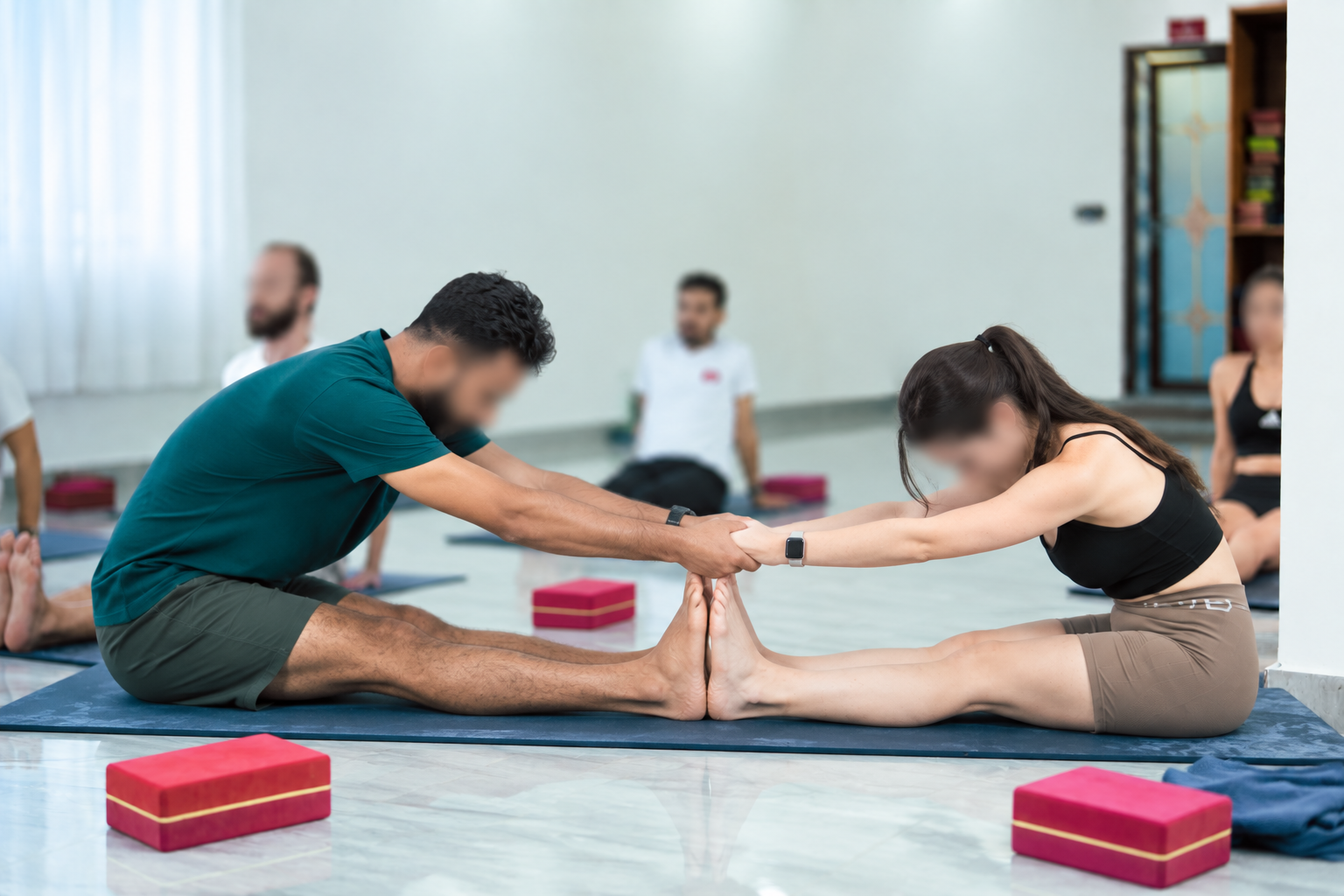
1. Partner Seated Forward Fold
Difficulty: 1/5
Best for: Hamstrings, back body, and learning how to communicate pressure
Sit facing each other with both legs stretched forward. Move close enough for your feet to meet comfortably. If either partner feels tightness at the back of the legs, keep a soft bend in the knees.
Hold each other’s hands or forearms.
One partner gradually leans backwards while the other folds forward from the hips. The person folding should say when the stretch feels sufficient.
Stay for three to five slow breaths. Return to the centre before changing roles.
Make it easier: Bend the knees or sit on a folded blanket.
Avoid this mistake: Do not pull your partner forward with your arms. The movement should be gradual and agreed upon.
Partner check-in: “Would you like less, the same, or slightly more stretch?”
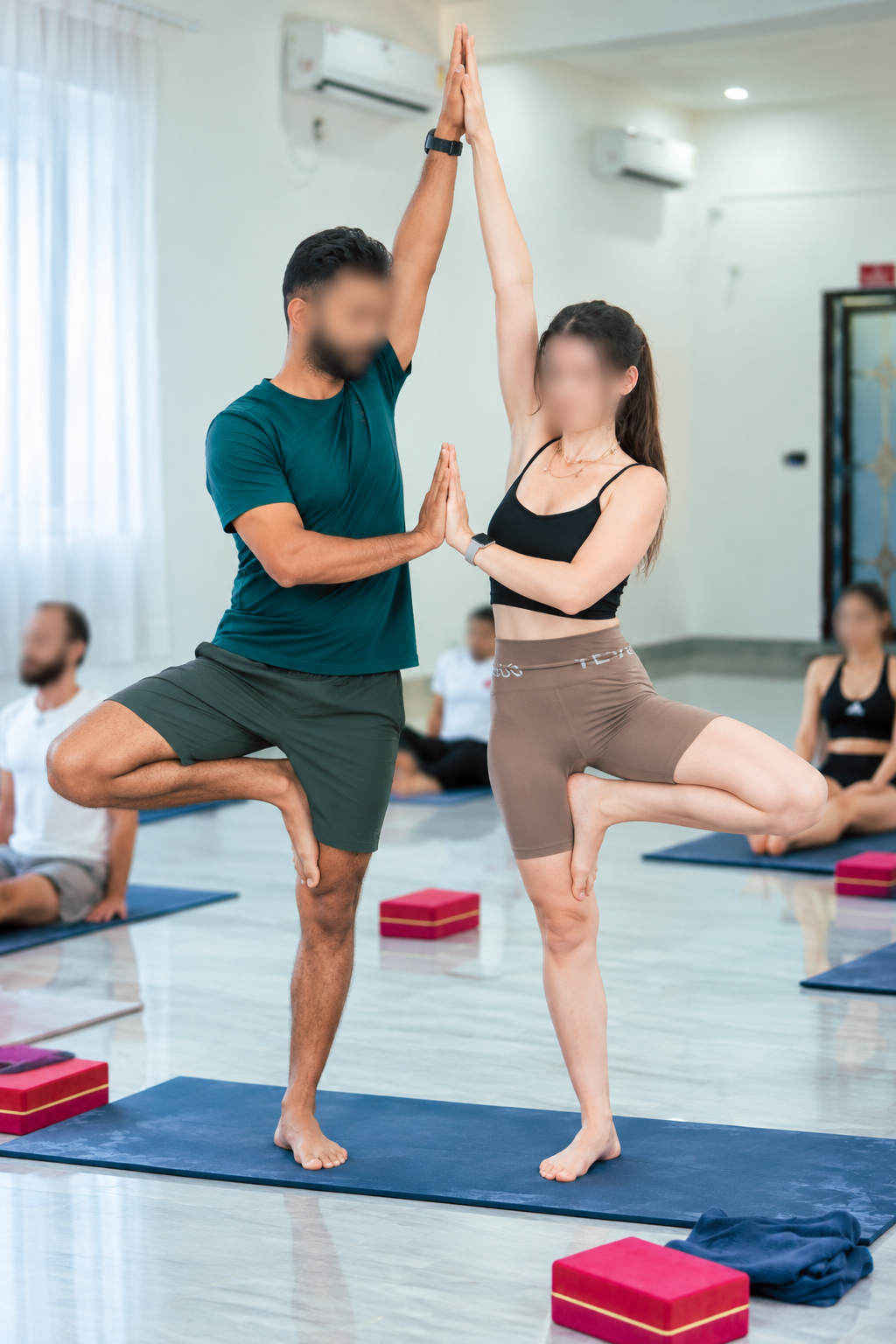
2. Double Tree Pose
Difficulty: 1/5
Best for: Balance, concentration, and mutual support
Stand next to one another and look forward. Use the arm nearest to your partner to hold them lightly around the waist or support their upper back.
Move your weight onto the leg closest to your partner. Bend the other knee and rest that foot near the ankle or along the inner calf of your standing leg.
If you both feel stable, bring the outside palms together above your heads or at chest level.
Hold for three to five breaths before changing sides.
Make it easier: Let the toes of the raised foot remain on the ground, with the heel resting lightly beside the ankle.
Avoid this mistake: Never press the lifted foot directly against the knee joint.
Partner check-in: “Are we supporting each other equally, or is one of us leaning?”
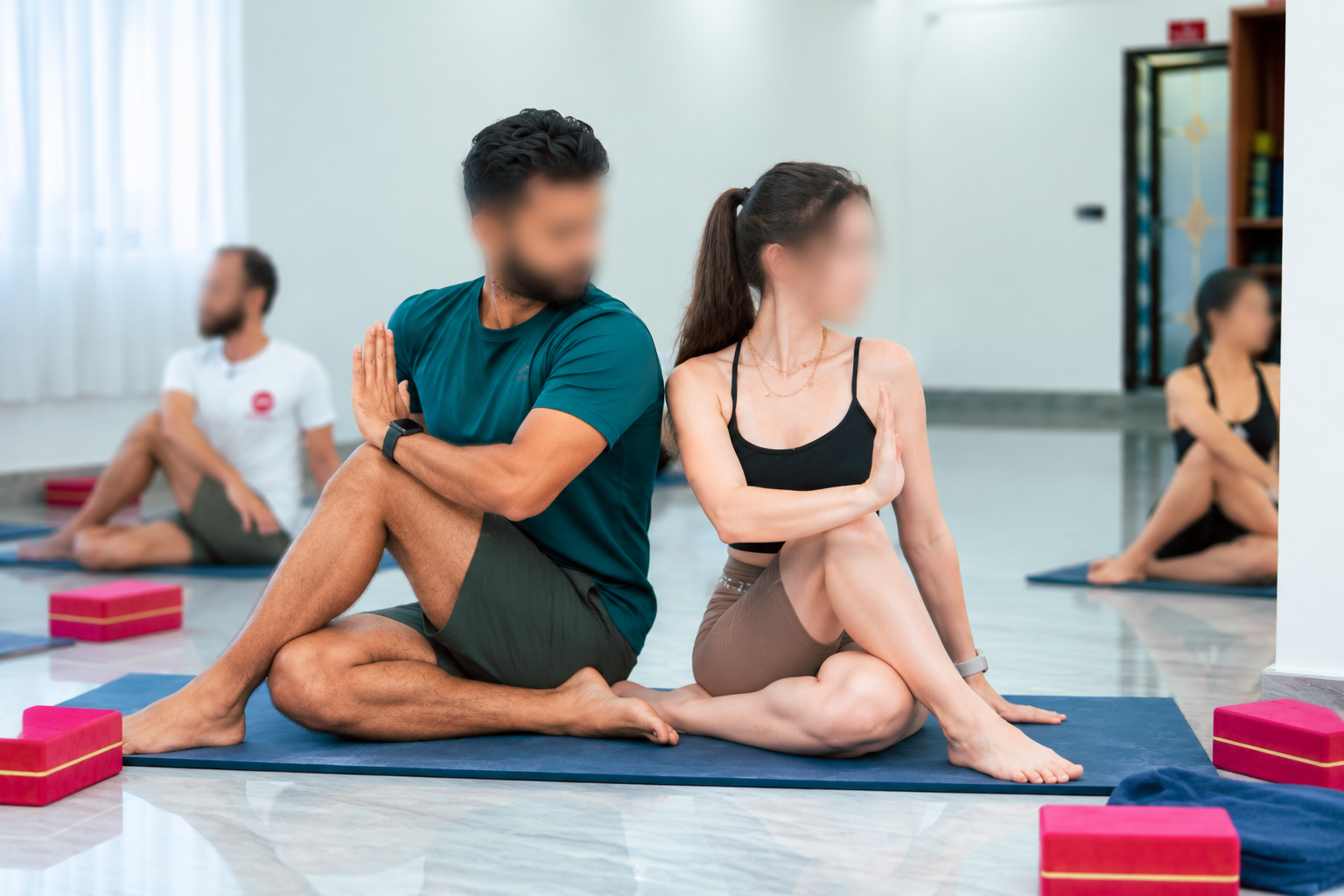
3. Seated Twist with a Partner
Difficulty: 1/5
Best for: Gentle spinal mobility and posture awareness
Sit back-to-back in a comfortable cross-legged position. If your knees or hips feel uncomfortable, sit on a cushion or use two chairs.
Take a breath in and sit taller. While breathing out, slowly rotate together to the right.
Reach your right hand towards your partner’s left knee, and rest your other hand on your own right knee. Keep your back tall and allow the shoulders to stay relaxed.
Remain there for three to five comfortable breaths. Slowly come back to the middle, then practise the twist towards the left.
Make it easier: Perform the twist while sitting on chairs.
Avoid this mistake: Do not use your partner’s knee to force yourself into a deeper rotation.
Partner check-in: “Can we both breathe comfortably here?”
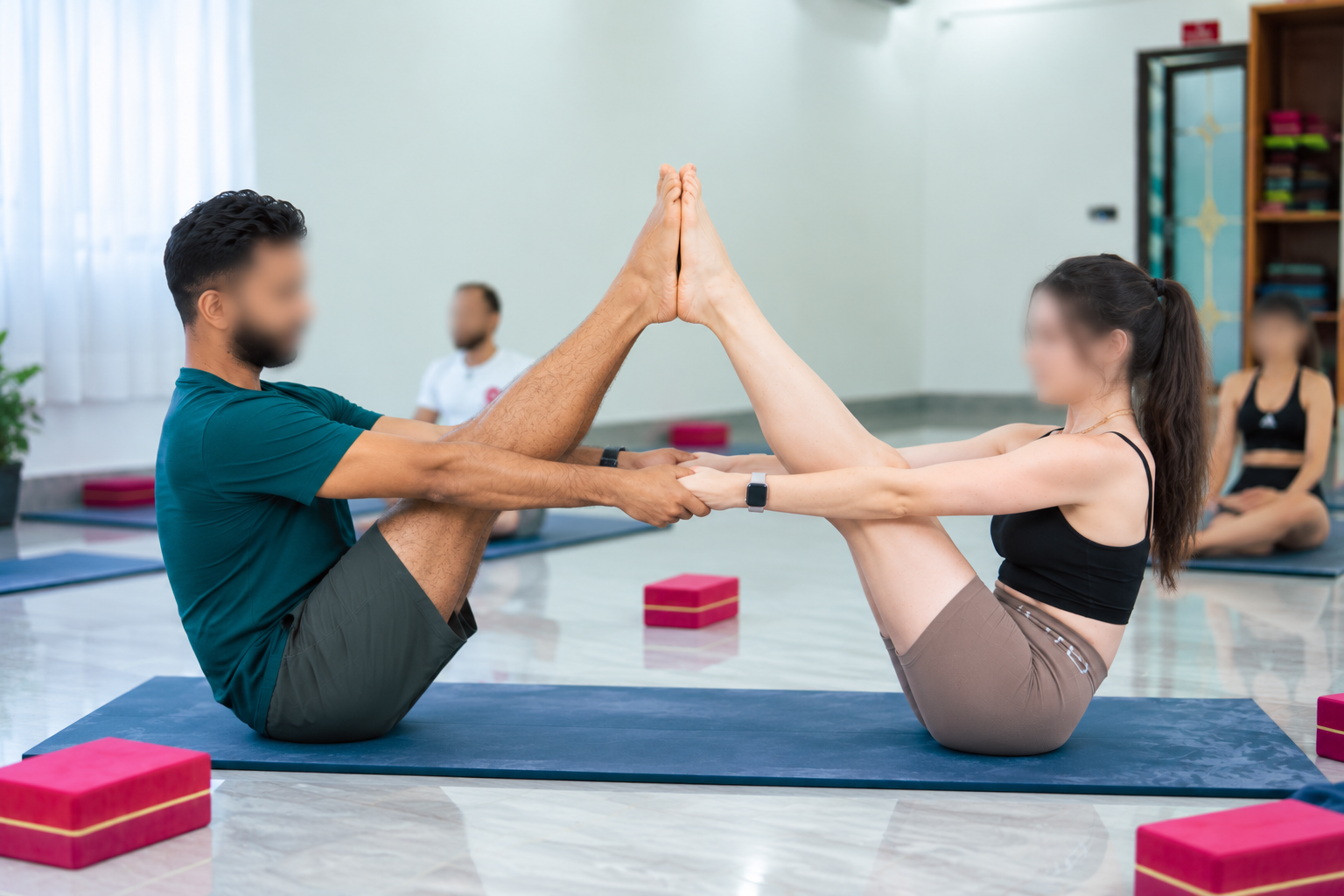
4. Partner Boat Pose
Difficulty: 2/5
Best for: Core strength, balance, and playfulness
Sit opposite each other with the knees folded. Hold each other’s hands or forearms, then gently connect your feet.
First, raise one connected pair of feet. If you both feel balanced, lift the other pair as well. Slowly lengthen the legs upward until they form an upside-down “W.”
Keep the chest open and the back comfortably upright. After three breaths, fold the knees with control and lower the feet to the mat.
Make it easier: Leave the knees folded, or extend only one connected pair of legs at a time.
Avoid this mistake: Do not collapse backwards or pull aggressively through the arms.
Partner check-in: “Are you ready to lift the second foot?”
This is one of the most enjoyable 2 person yoga poses easy enough to adapt for different levels.
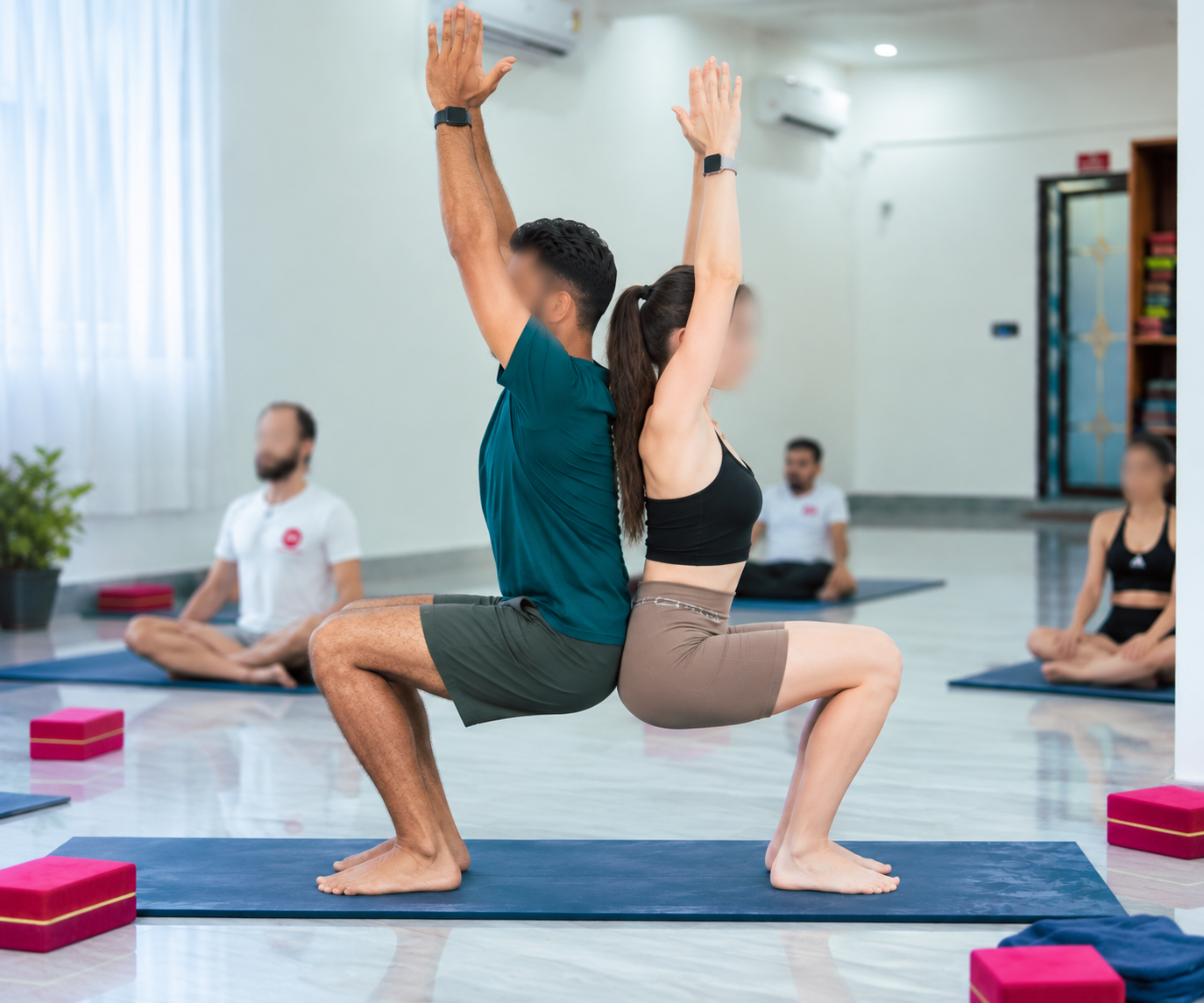
5. Back-to-Back Chair Pose
Difficulty: 2/5
Best for: Legs, core, coordination, and teamwork
Stand back-to-back with your feet approximately hip-width apart. Gently connect through the backs of your hips and upper bodies.
Take a few small steps forward while keeping your backs connected. Breathe out together, soften the knees, and lower your bodies at the same pace.
Pause at a level that feels manageable for both of you. Keep each knee pointing towards the toes rather than falling inward.
Hold for three to five breaths. Count to three and press through the feet to rise together.
Make it easier: Descend only a short distance.
Avoid this mistake: Do not lower suddenly or assume your partner is ready.
Partner check-in: “Shall we stay here or rise?”
Intermediate Couple Yoga Poses
Intermediate couples yoga poses demand more balance, strength, and control. Both partners should first understand the individual version of the posture.
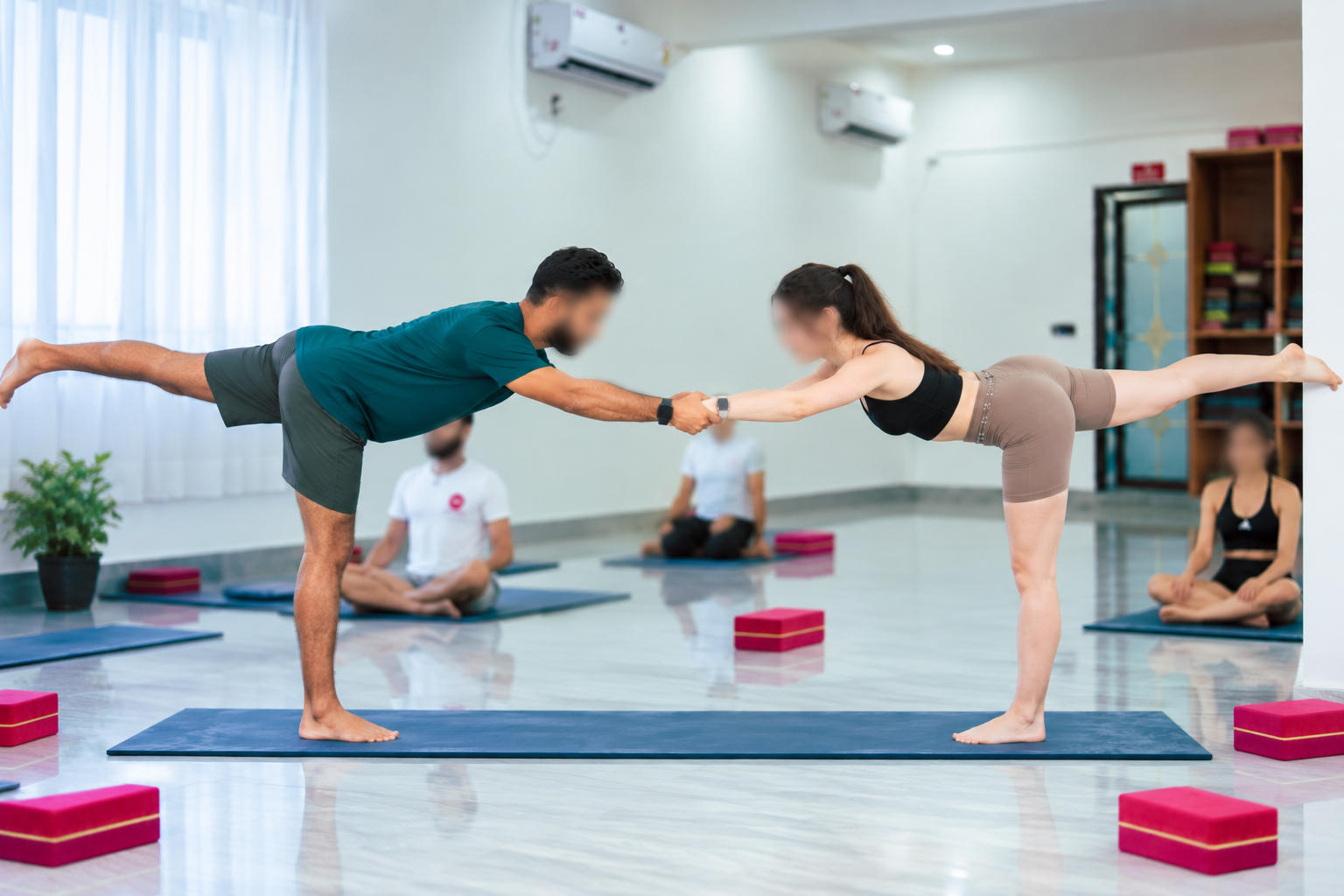
6. Partner Warrior III
![]()
Difficulty: 3/5
Best for: Stability, leg strength, and concentration
Begin opposite one another and connect through the hands or forearms. Move apart until you both have enough room to lean forward from the hips.
Balance on one leg while reaching the other leg behind you. At the same time, guide the upper body forward in a slow and controlled movement.
Keep the standing knee softly engaged and the hips as level as comfortably possible. Look towards the floor rather than lifting the chin.
Hold for three breaths and return with control. Repeat on the other side.
Make it easier: Allow the toes of the back leg to touch the ground, or use a nearby wall for extra balance.
Avoid this mistake: Do not hang backwards from your partner’s arms.
Partner check-in: “Do you feel stable enough for me to move?”
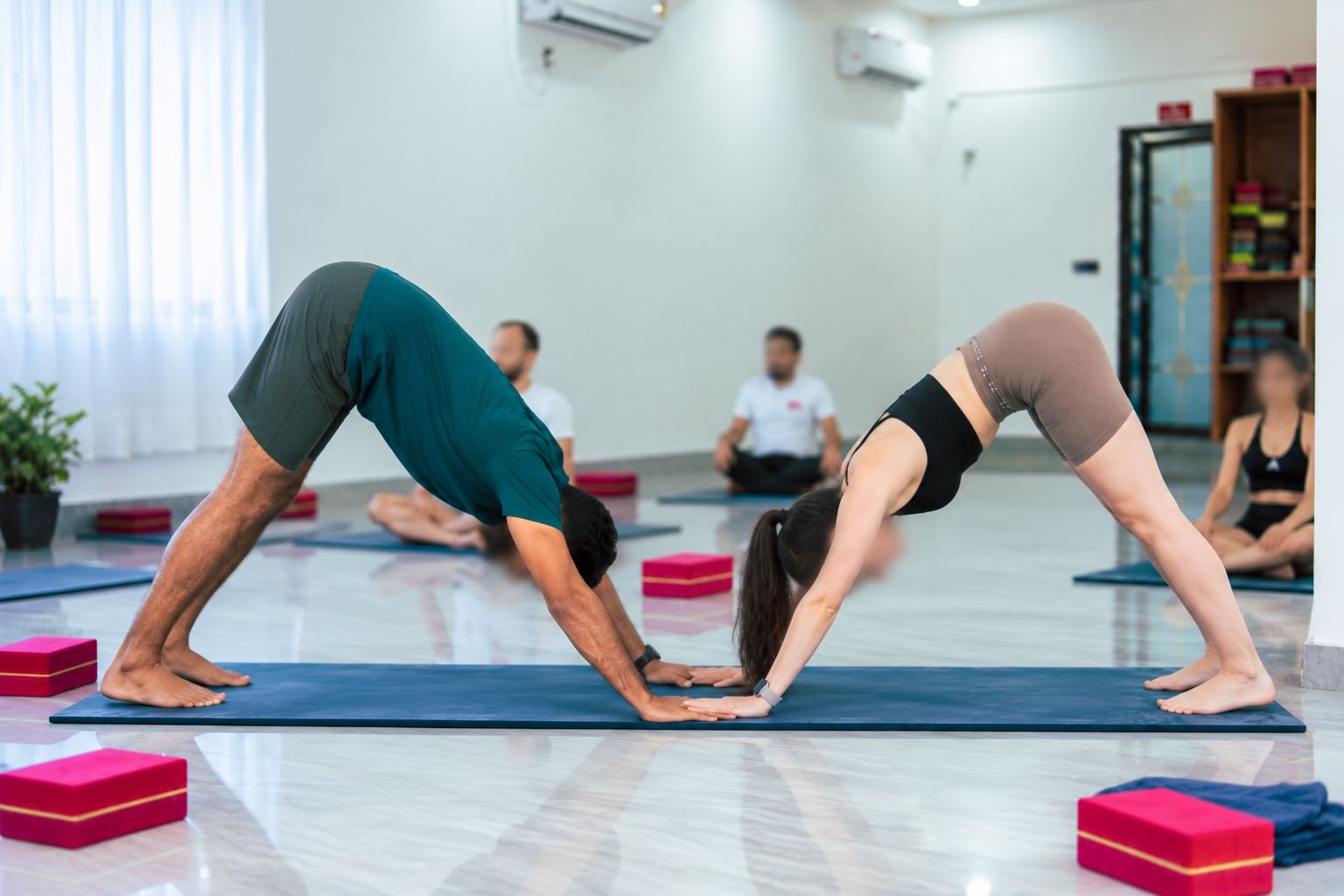
7. Double Downward Dog
Difficulty: 3/5
Best for: Shoulder strength, back-body length, and controlled weight sharing
Partner One, the base, begins in Downward-Facing Dog. Partner Two stands near the base’s hands, facing away.
Partner Two places both hands firmly on the mat and carefully transfers one foot at a time onto the appropriate supported area near the base’s pelvis or sacrum, according to the variation taught by an instructor.
The upper partner lengthens into an elevated Downward Dog shape while avoiding sudden pressure on the base’s spine.
Make it easier: Practise a Downward Dog and Child’s Pose combination without stacking body weight.
Avoid this mistake: Do not place the feet randomly on the base’s back after copying a photograph.
Safety note: Learn this posture from a competent teacher. Avoid it if either partner has significant wrist, shoulder, neck, or spinal concerns.
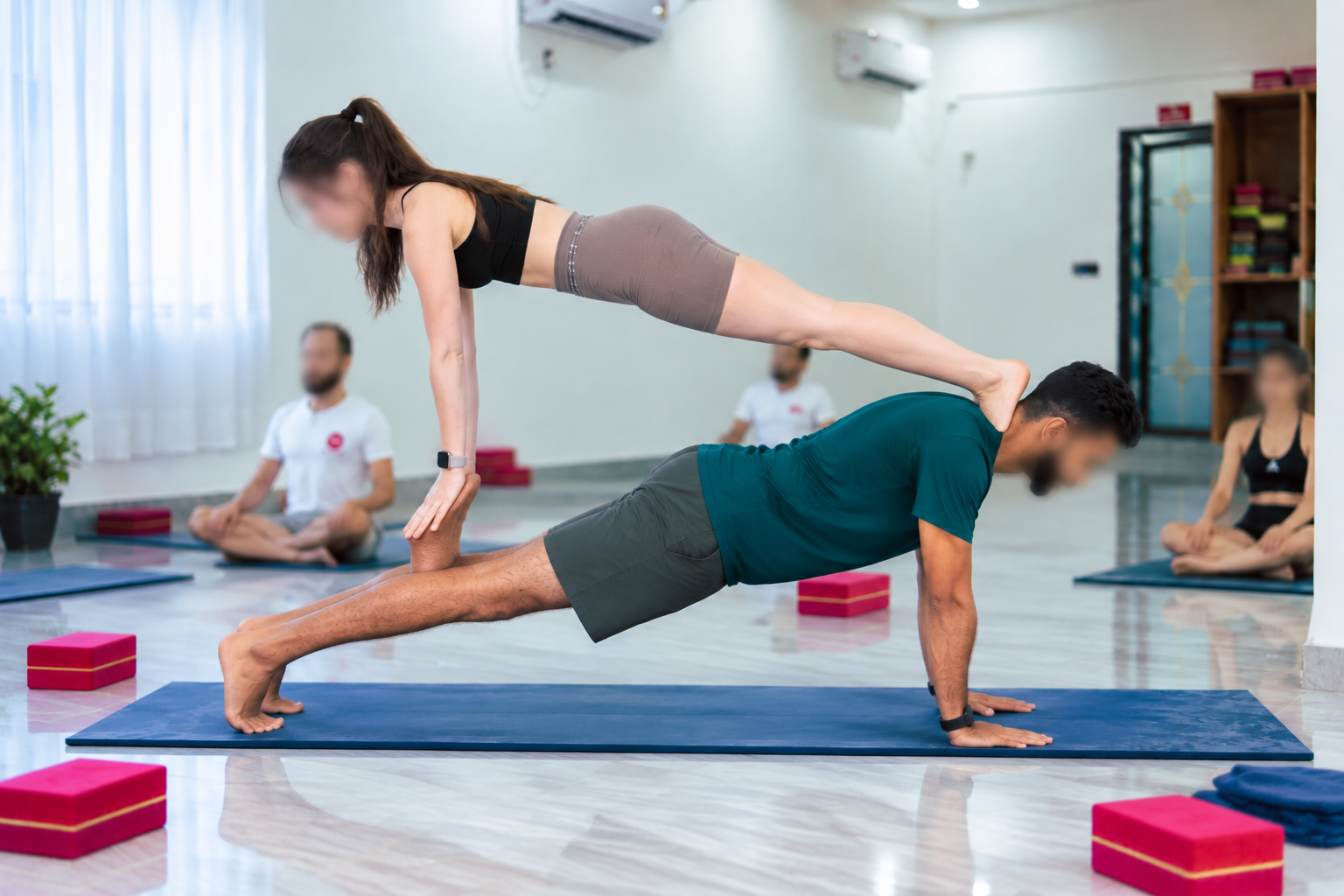
8. Flying Plank Pose
Difficulty: 4/5
Best for: Core engagement, whole-body strength, and trust
The base begins lying down, with both knees folded. The flyer stands close to the base’s feet and looks towards them.
The partners hold hands. The base positions the feet carefully near the flyer’s hip creases. The flyer maintains an active plank-like body and gradually leans forward.
With clear communication, the base extends the legs to lift the flyer.
Hold briefly before reversing the steps slowly.
Make it easier: Practise the weight transfer without fully lifting the flyer.
Avoid this mistake: The flyer should not suddenly relax, and the base should not push into the abdomen.
Safety note: Use a trained spotter while learning.
9. Supported Partner Camel Pose
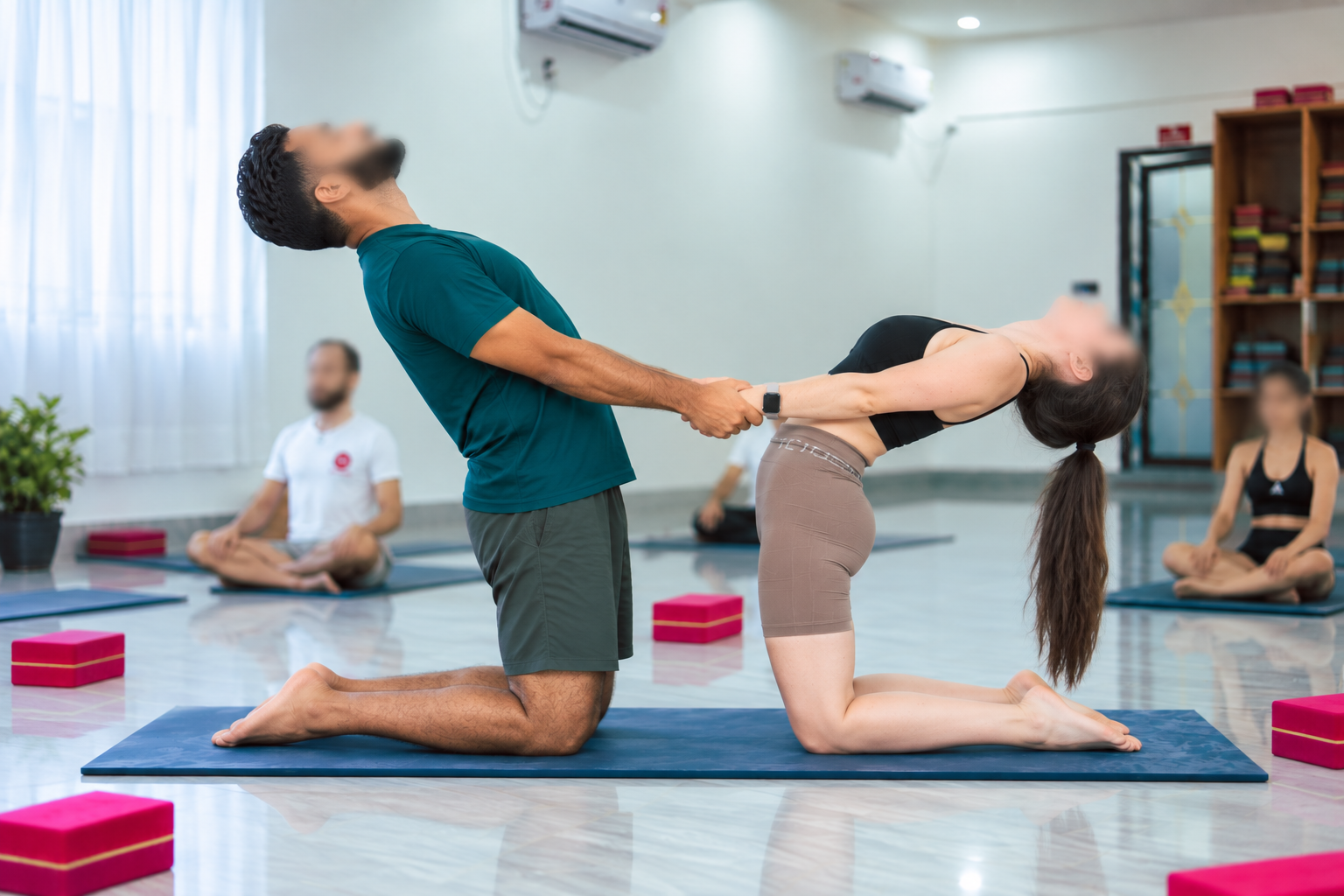
Difficulty: 3/5
Best for: Chest opening, upright posture, and controlled backbending
Kneel in a stable position according to the partner variation being used. Before bending backwards, engage the thighs and lift through the chest.
Both partners move only as far as they can maintain length through the spine and steady breathing. Depending on the variation, the arms or upper back may provide gentle support.
Make it easier: Keep both hands at the lower back or practise a high kneeling chest opener without a deep backbend.
Avoid this mistake: Do not throw the head backwards or compress the lower back.
Partner check-in: “Do you feel supported, or would you like to come higher?”
People with neck, knee, or lower-back concerns should choose a gentler alternative.
Advanced Partner Yoga Poses
Hard yoga poses for two people require far more than confidence. They demand technique, strength, timing, spatial awareness, and safe exit skills.
Do not turn difficult yoga poses for two people into an impulsive challenge. Learn them with a qualified partner-yoga or acro-yoga instructor and use a spotter.
10. Flying Superman Pose
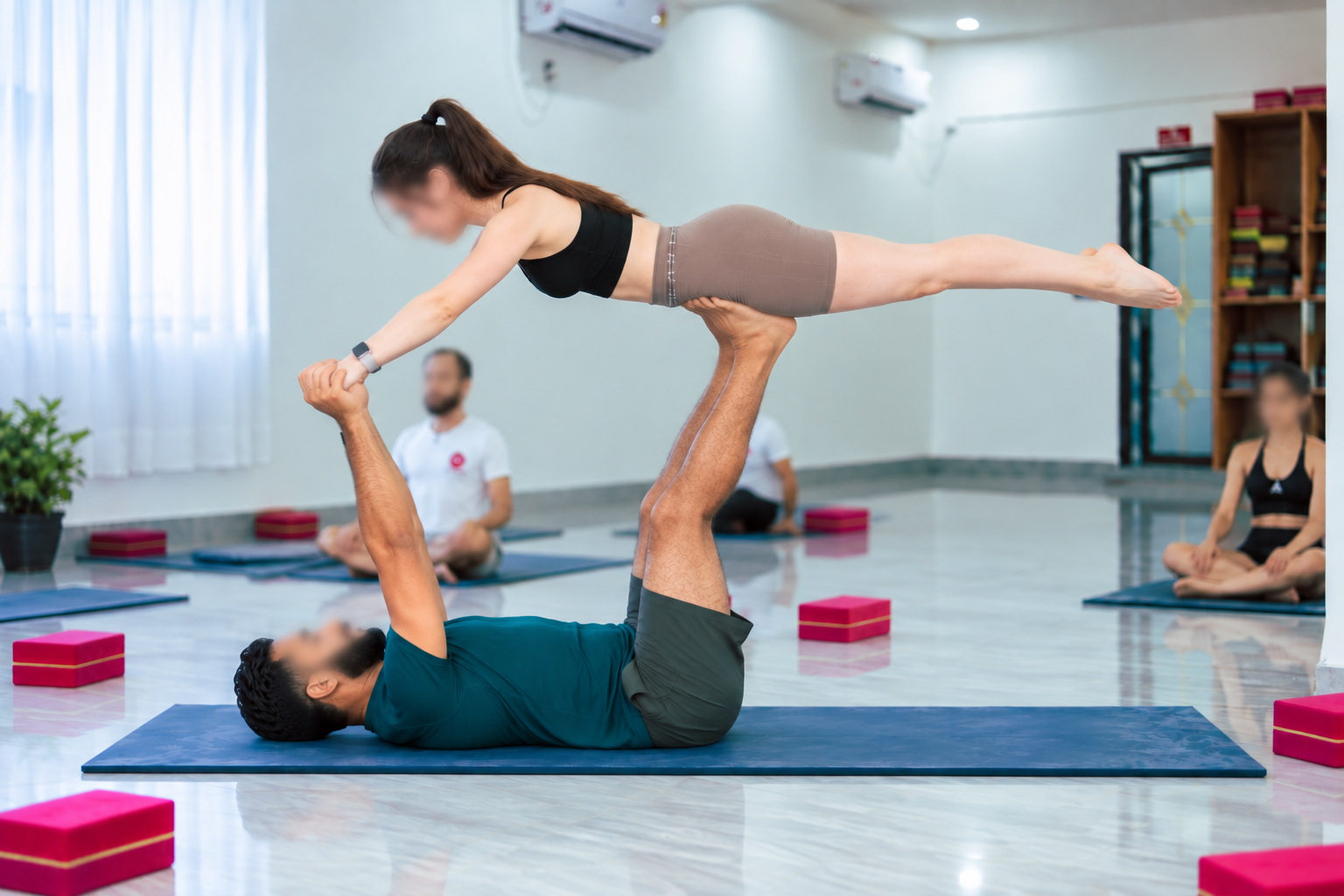
Difficulty: 5/5
Best for: Advanced balance, core control, and coordinated movement
The base lies on their back and places the feet carefully against the flyer’s pelvic region according to trained alignment.
The flyer faces away and gradually transfers weight onto the base’s feet. Once the flyer is stable and engaged, the base extends the legs upward.
The flyer lengthens the arms forward and legs backwards to create the flying shape.
Essential safety points:
· Use an experienced spotter.
· Agree on verbal signals before lifting.
· Keep the base’s legs controlled.
· Never enter or exit with sudden momentum.
· Lower immediately if either person loses control.
11. Acro Yoga Front Bird Pose
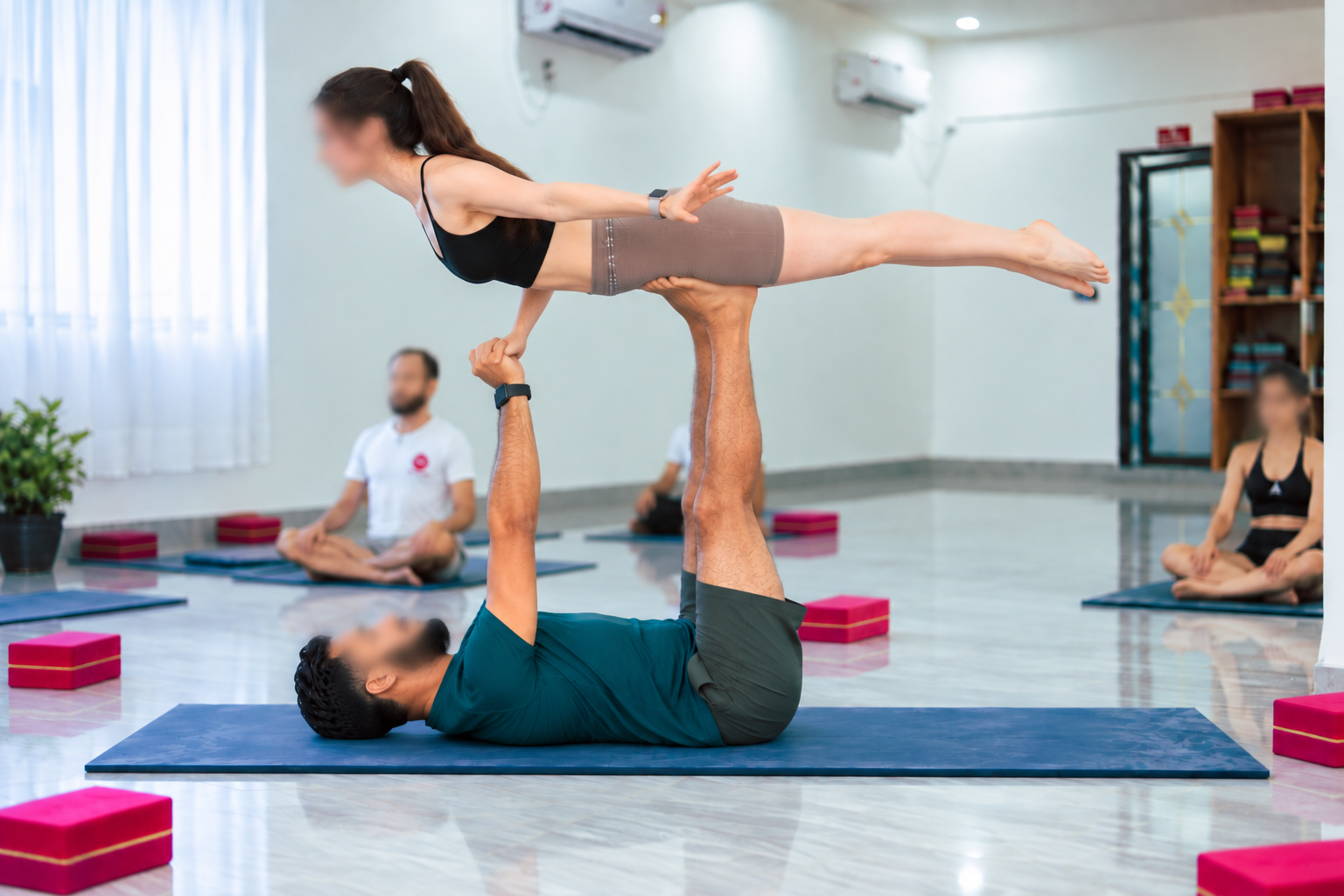
Difficulty: 5/5
Best for: Balance, trust, and acro-yoga foundations
The base starts in a resting position on the back, keeping both knees folded. The flyer takes a standing position close to the base.
The base positions the feet in the flyer’s hip creases while both partners connect through the hands. The flyer leans forward with an active core as the base gradually extends the legs.
The hand connection should be released only when both partners are stable and an experienced spotter is present.
Avoid this mistake: Poor foot placement can make the pose uncomfortable and unstable. Learn the correct points of contact directly from a teacher.
12. Partner Handstand Support
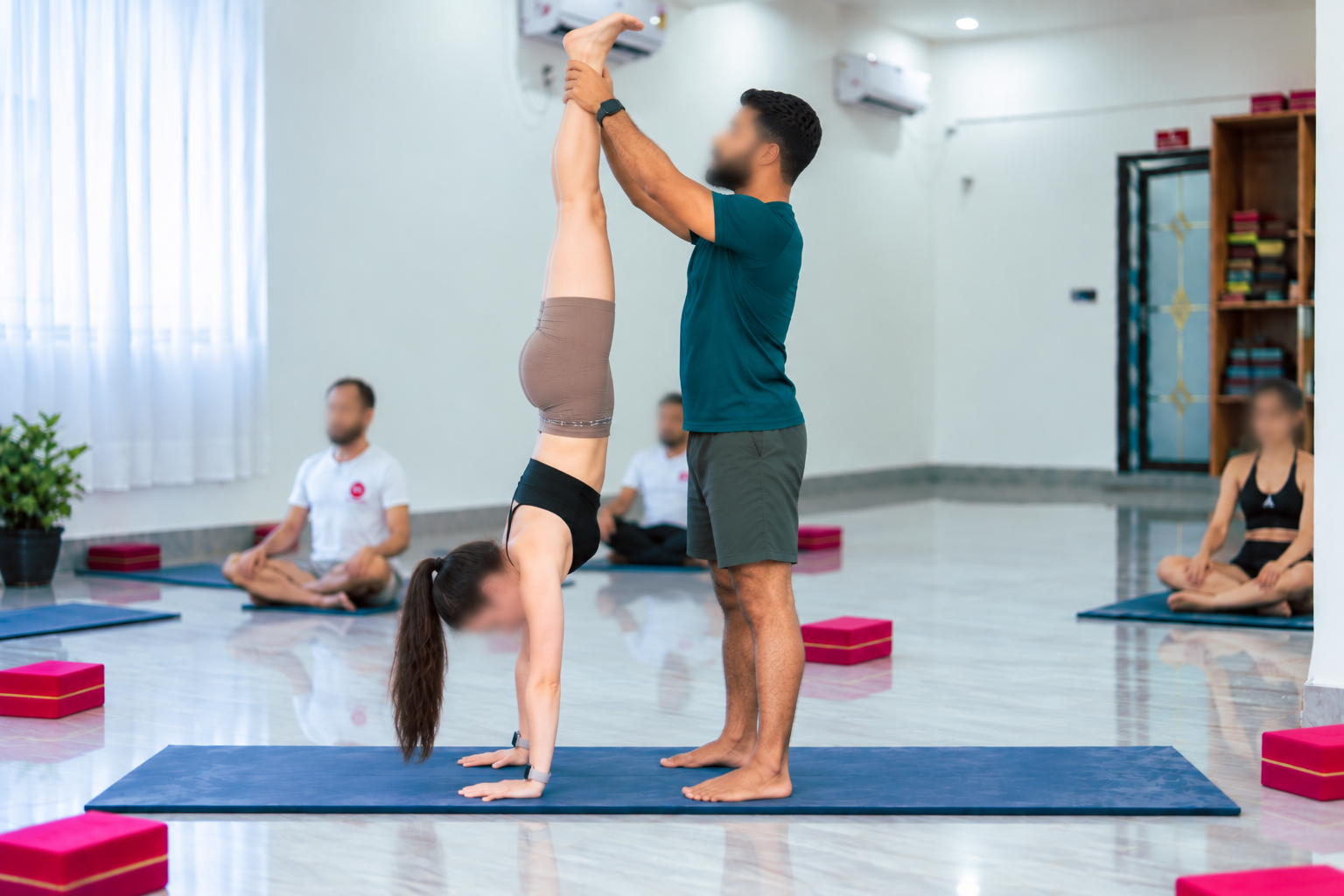
Difficulty: 5/5
Best for: Inversion control, shoulder strength, and confidence
One partner enters a handstand while the second provides carefully controlled support at the legs or hips.
Before trying the partner version, the person performing the handstand should understand wall-supported handstand alignment and know how to exit safely.
The supporting partner should follow instructions rather than pulling or repositioning the legs unexpectedly.
Avoid this posture if you have relevant wrist, shoulder, neck, blood-pressure, eye-pressure, or balance-related concerns unless you have received appropriate medical and professional guidance.
A 30-Minute Couple Yoga Routine for Beginners
You do not need to attempt 100 yoga poses for two people to have a meaningful practice. Seven carefully chosen postures performed with awareness are more valuable than dozens performed carelessly.
Part One: Arrive Together—5 Minutes
Sit back-to-back in a comfortable position.
Close your eyes and notice the movement of your partner’s back as they breathe. Do not try to force your breaths into the same rhythm immediately.
After one minute, gradually explore a shared rhythm:
· Inhale gently for four counts.
· Exhale comfortably for four counts.
· Continue for five rounds without straining.
Complete a few shoulder rolls, side stretches, wrist movements, Cat–Cow movements, and gentle hip circles.
Part Two: Partner Flow—20 Minutes
Move through the following sequence:
1. Double Tree Pose: Three to five breaths on each side
2. Partner Seated Forward Fold: Five breaths for each partner
3. Seated Partner Twist: Three to five breaths on both sides
4. Partner Boat Pose: Two rounds of three breaths
5. Back-to-Back Chair Pose: Three to five breaths
6. Partner Warrior III: Three breaths on each side
7. Supported seated side stretch: Five breaths on each side
Pause between postures whenever required. Do not rush simply to complete the entire sequence.
Part Three: Rest and Reconnect—5 Minutes
Lie beside each other in Savasana or return to a back-to-back seated position.
Allow your breathing to become natural.
Silently notice:
· One moment when your partner supported you
· One moment when you communicated honestly
· One quality you appreciated in the other person
· One thing you would approach differently next time
To close the practice, turn towards each other. Bring the palms together at the heart or simply make comfortable eye contact.
Each person completes one sentence:
“During today’s practice, I appreciated…”
This small ritual transforms the routine from a collection of yoga poses into a genuinely shared experience.
Try This 2 Person Yoga Challenge
A 2 person yoga challenge should test awareness—not recklessness.
Instead of trying to complete the most impressive pose, use this seven-day challenge:
· Day 1: Practise five minutes of back-to-back breathing.
· Day 2: Learn Double Tree Pose without blaming each other for wobbling.
· Day 3: Practise Partner Forward Fold using clear pressure cues.
· Day 4: Hold Partner Boat Pose for three calm breaths.
· Day 5: Create a short flow of three easy poses.
· Day 6: Practise one intermediate pose with suitable guidance.
· Day 7: Repeat your favourite poses and finish with partner meditation.
The challenge is successful if both people feel safer, more aware, and more connected—not if you manage to take a dramatic photograph.
Common Mistakes During Couple Yoga
Treating your partner like yoga equipment
Your partner has their own limits, fears, and preferences. Never move their body without communication.
Skipping the warm-up
Cold muscles and unprepared joints are not ready for deep stretching, lifting, or weight-bearing movements.
Forcing flexibility
A partner-assisted stretch can become excessive quickly. Stop before the stretch changes into pain, pinching, numbness, or joint pressure.
Moving without warning
Count down before lifting, lowering, changing sides, or releasing a hand connection.
Holding the breath
If you cannot breathe steadily, reduce the intensity or leave the posture.
Comparing bodies
Different limb lengths, proportions, strength levels, and mobility can change the appearance of a pose. The posture does not need to look perfectly symmetrical to be useful.
Choosing poses only for photographs
A beautiful photograph does not prove that the entry, hold, or exit was safe. Build the necessary foundations before attempting hard yoga poses for two people.
Assuming trust means having no boundaries
Healthy trust includes the confidence to say “no,” “pause,” or “out.” Ignoring discomfort is not trust.
Final Thoughts
Yoga poses for two people offer something that an individual practice cannot provide in exactly the same way: immediate feedback from another human being.
Your partner’s movement shows whether you are rushing. Their breathing tells you whether the position may be too demanding. Their trust reminds you to move responsibly.
Begin with easy couples yoga poses that keep both people close to the floor. Learn to communicate before progressing to difficult balances. Build steadiness before attempting to fly.
You may wobble. You may misunderstand each other. You may have to leave a posture and begin again. That does not make the practice unsuccessful. In many ways, that is the practice.
The deepest purpose of couple yoga is not to create two perfect bodies in one impressive pose. It is to help two people become more present, more honest, and more considerate while moving together.
Support without controlling. Communicate without blaming. Challenge yourselves without ignoring your limits.
And when the posture ends, allow the awareness and patience you developed on the mat to continue into the way you relate to each other beyond it.