There's a story about K. Pattabhi Jois, the man most responsible for bringing Ashtanga yoga to the world. A student once asked him why the sequence never changed. Why couldn't they just do different poses on different days? Jois looked at the student with complete calm and said: “You practice. All is coming.”
That was it.
That philosophy is really simple but surprisingly radical and it is at the heart of what Ashtanga yoga actually is. And if you've been curious about it but weren't sure where to start, you're in the right place.
Let’s talk about what has made Ashtanga yoga one of the most celebrated spiritual and wellness practice in the world.
What Is Ashtanga Yoga?
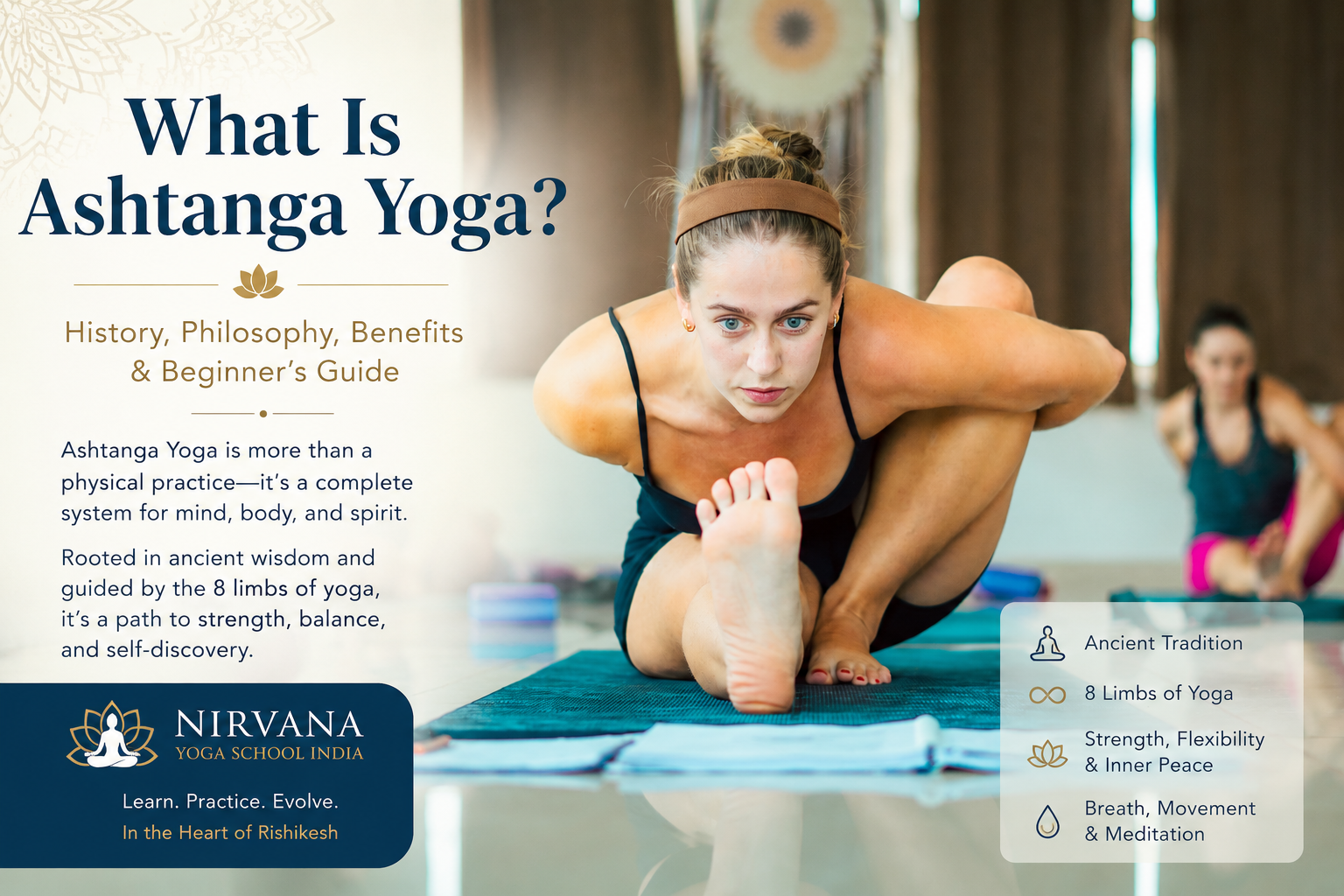
The word Ashtanga comes from Sanskrit. Ashta meaning eight, and anga meaning limb or branch. Put them together and you get "eight limbs," referring to the eight-part path laid out by the sage Patanjali in the Yoga Sutras, written roughly 1,700 years ago.
So at its core, Ashtanga yoga is a complete philosophical system for how to live. The physical practice that most people associate with it today is technically just one of those eight limbs. It's the third one, actually. Asana (posture) comes after two whole chapters about ethics and personal discipline.
If you're looking to learn Ashtanga Yoga in its traditional setting, studying with experienced teachers at Nirvana Yoga School can help you build a strong foundation in both the physical practice and the deeper philosophy of yoga.
History and Origins of Ashtanga Yoga
Patanjali and the Yoga Sutras
Around 400 CE, a scholar named Patanjali compiled a remarkable text: the Yoga Sutras. 196 short aphorisms. Each one dense enough to build a doctoral dissertation on.
Nobody knows much about Patanjali the person. Some traditions say he was a divine being who descended to earth specifically to write this text. Others think "Patanjali" might have been a collective name for a school of scholars. What everyone agrees on is that the Yoga Sutras became the foundational text of classical yoga philosophy, and the eight-limb path it describes is still the framework serious yoga practitioners work within today.
Krishnamacharya: The Man Who Changed Everything
Fast forward to 1920s Mysore, India. A scholar and healer named Tirumalai Krishnamacharya had studied yoga under a teacher in a cave in Tibet for seven years. He returned with a vast knowledge of yogic texts and an extraordinary physical practice.
The Maharaja of Mysore, a yoga enthusiast, essentially gave Krishnamacharya a school and said: go teach. This was arguably the most consequential moment in the history of modern yoga.
Krishnamacharya is known as the "father of modern yoga" because virtually every major lineage of yoga practiced in the West today traces back to him. He taught B.K.S. Iyengar (who founded Iyengar Yoga), T.K.V. Desikachar (his own son, who developed Viniyoga), and most importantly for our purposes, a young student named K. Pattabhi Jois.
K. Pattabhi Jois and Modern Ashtanga Yoga
Sri K. Pattabhi Jois (affectionately called "Guruji" by his students) began teaching what he called Ashtanga yoga in Mysore in the 1940s. He taught out of a small shala (yoga school) called the Ashtanga Yoga Research Institute, which he ran until his death in 2009 at age 93.
For decades, his students were primarily Indian. Then, in the 1970s, a handful of American and European practitioners found their way to Mysore. They went home transformed, and they brought the practice with them. By the 1990s, Ashtanga yoga had spread across the United States, Europe, and Australia, becoming one of the world's most widely practiced yoga systems.
Today, Jois's granddaughter Sharath Jois leads the KPJAYI (K. Pattabhi Jois Ashtanga Yoga Institute) in Mysore, continuing the lineage.
The 8 Limbs of Ashtanga Yoga Explained
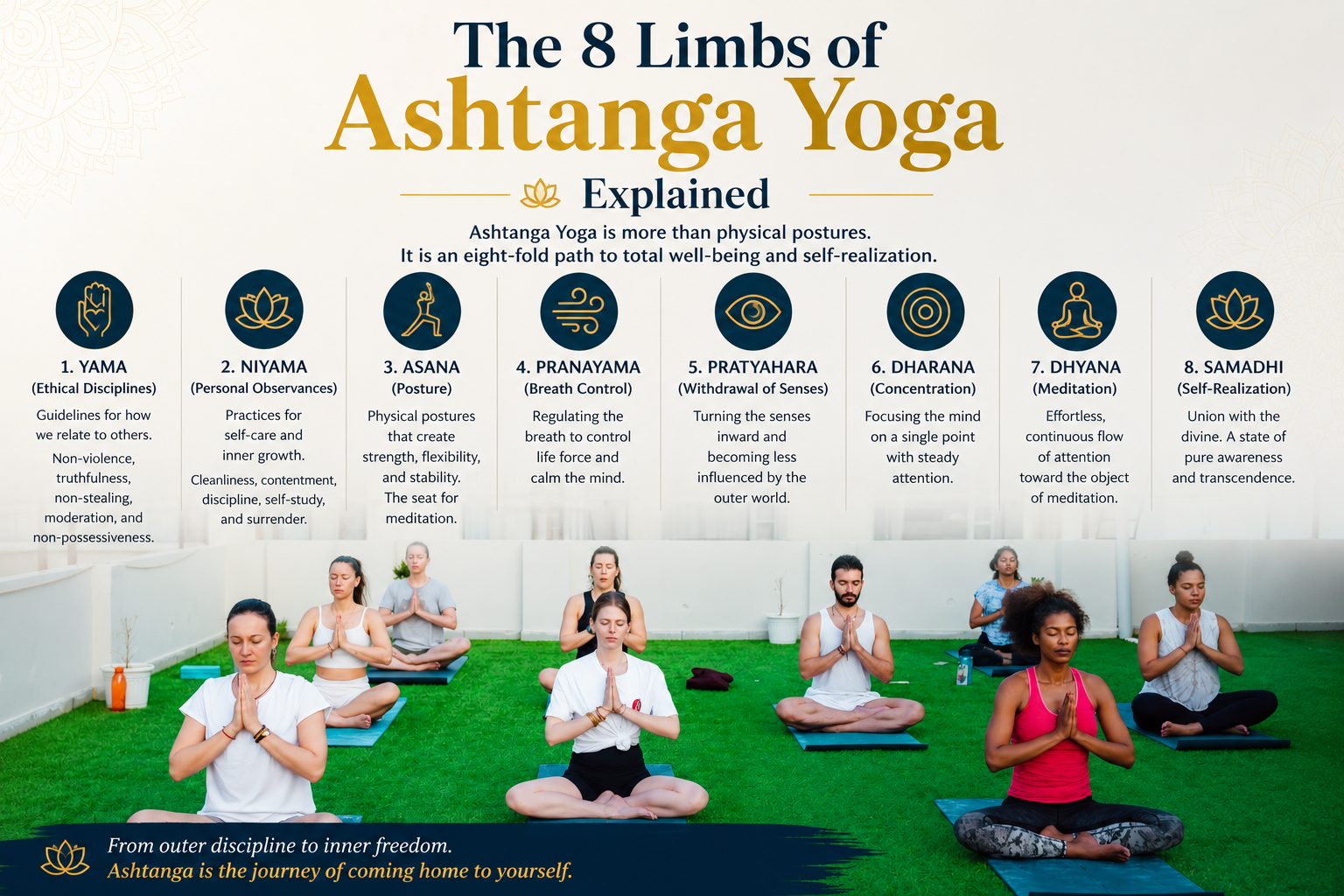
The eight limbs of Ashtanga Yoga are not as eight separate practices, but as eight interconnected dimensions of a single path. You work all of them simultaneously, over a lifetime.
Here are all of them:
1. Yama
The Yamas are ethical guidelines for how you relate to others. There are five: Ahimsa (non-violence - in thought, word, and action), Satya (truthfulness), Asteya (non-stealing), Brahmacharya (wise use of energy, traditionally interpreted as celibacy but more broadly as avoiding excess), and Aparigraha (non-grasping, or not holding on to more than you need).
They're practical observations about what happens to a mind that operates from cruelty, dishonesty, or greed.
2. Niyama
Where Yamas govern external relationships, Niyamas govern your inner life. Also five: Saucha (cleanliness, inside and out), Santosha (contentment), Tapas (disciplined effort, the willingness to be uncomfortable in service of growth), Svadhyaya (self-study, including scripture and self-reflection), and Ishvara Pranidhana (surrender to something larger than yourself, whether you call it God, nature, the universe, or something else entirely).
3. Asana
This is the limb people sign up for and then discover leads to all the others. Patanjali's original definition of asana was wonderfully minimal: sthira sukham asanam - a posture that is steady and comfortable. That's it.
4. Pranayama
Prana is life force. Ayama means to extend or regulate. Pranayama is the practice of consciously working with the breath to regulate the flow of prana in the body.
In Ashtanga yoga, pranayama is woven into the asana practice through ujjayi breathing (more on this shortly). There are also dedicated pranayama practices, traditionally introduced after the student has established a stable asana practice.
5. Pratyahara
Imagine a tortoise pulling its limbs inside its shell. That image, which appears in the Bhagavad Gita, is the traditional metaphor for Pratyahara. The senses stop being pulled outward by every sound, sight, and sensation. You become less reactive to external stimulation. Interestingly, a consistent asana and pranayama practice tends to naturally develop this quality.
6. Dharana
Fixing the mind on a single point. In asana practice, this is partly achieved through drishti, the specific gaze point associated with each posture. You're deliberately narrowing the field of attention.
7. Dhyana
Dharana is holding the attention. Dhyana is when the effort becomes effortless, the mind is absorbed in its object without struggle. The distinction between the meditator and the thing meditated on begins to dissolve. This is not something you can force; it's what happens when the earlier limbs have done their work.
8. Samadhi
The word Samadhi is often translated as "enlightenment" or "liberation," but it means something more precise: complete absorption, the dissolution of the separate self into the object of meditation. There are many levels of Samadhi described in the Yoga Sutras, ranging from temporary states of absorption to permanent transformation. It's the destination on a very long road… which is exactly why Pattabhi Jois said: just practice.
What Makes Ashtanga Yoga Unique?
Walk into a hundred different yoga classes and you'll experience a hundred different sequences, music choices, moods, and teaching styles. Walk into an authorized Ashtanga class anywhere on earth and you'll recognize it immediately. That consistency is what makes Ashtanga genuinely distinctive:
- The Fixed Sequence: Every Ashtanga class follows the same sequence of poses in the same order. The idea is that the sequence itself becomes a mirror as you repeat it hundreds of times, you stop thinking about what comes next and start noticing what's actually happening in your body and mind.
- Vinyasa: Each movement in Ashtanga is synchronized with either an inhale or an exhale. The linking breath-movement transitions (called vinyasa) build heat, maintain focus, and keep the practice fluid rather than episodic.
- Ujjayi Breathing: The specific breathing technique used throughout Ashtanga practice is called ujjayi pranayama, sometimes translated as "victorious breath" or less poetically as "ocean breath." It involves a slight constriction at the back of the throat, creating an audible sound, like the ocean in a shell.
- Drishti: Each posture has a prescribed drishti. There are nine: the nose, the space between the eyebrows, the navel, the hand, the toes, the thumb, the side (far right or left), and upward toward the sky. Drishti prevents the eyes from wandering, which in turn prevents the mind from wandering. It's concentration practice built directly into the physical practice.
- Bandhas: These are subtle muscular contractions that redirect the flow of prana (life energy) in the body. The three primary ones in Ashtanga are: Mula Bandha (root lock), Uddiyana Bandha (upward-flying lock), and Jalandhara Bandha (chin lock). Together, these three are called Tri Bandha or Maha Bandha (the great lock).
Ashtanga Yoga Primary Series Explained
The Ashtanga system contains six series of increasing difficulty. Most practitioners spend their entire practice lives in the first. The Primary Series, called Yoga Chikitsa in Sanskrit, meaning "yoga therapy", is designed to realign and detoxify the body, building the foundation for everything that follows.
| Section | Purpose |
| Opening chant | Setting intention, centering the mind |
| Sun Salutation A (5x) | Building heat, establishing breath rhythm |
| Sun Salutation B (5x) | Deepening heat, adding strength and hip work |
| Standing poses | Building strength, balance, and opening the hips and hamstrings |
| Seated poses | Forward bends, twists, and hip openers; the core of Primary Series |
| Backbends | Counteracting all the forward bending; opening the chest and spine |
| Finishing sequence | Inversions, supported poses, pranayama, Savasana |
Common Ashtanga Yoga Poses for Beginners
Tadasana (Mountain Pose)
Benefits: Improves posture, builds body awareness, strengthens legs and core.
How to do it: Stand with feet together (or hip-width for beginners), weight evenly distributed across all four corners of each foot. Lift the kneecaps, engage the thighs, lengthen the tailbone down, draw the lower belly gently in. Stack your shoulders over your hips, chin parallel to the floor, crown of the head lifting.
Beginner modification: Stand with feet hip-width apart if balance is difficult. Focus on feeling your feet press into the floor before worrying about anything above.
Trikonasana (Triangle Pose)
Benefits: Stretches hamstrings, hips, and spine. Strengthens the legs and core. Improves balance and spatial awareness.
How to do it: Stand with feet wide, right foot turned out 90 degrees, left foot slightly in. Extend arms parallel to floor. Reach forward with the right hand, then hinge at the hip (not the waist) and bring the right hand to the shin, ankle, or floor. Left arm reaches straight up. Turn the gaze toward the left hand.
Beginner modification: Use a block under the bottom hand. Focus on keeping both sides of the torso long rather than reaching the floor.
Paschimottanasana (Seated Forward Fold)
Benefits: Stretches the entire posterior chain from heels to head. Calms the nervous system. Stimulates digestion.
How to do it: Sit with legs extended. Inhale to lengthen the spine. Exhale to fold forward from the hip crease. Reach for the feet, holding the outer edges, the toes, or wherever you can reach without rounding dramatically. With each inhale, lengthen. With each exhale, deepen.
Beginner modification: Bend the knees generously. Place a folded blanket under the hips to tilt the pelvis forward. Use a strap around the feet if they're far away.
Bhujangasana (Cobra Pose)
Benefits: Strengthens the muscles along the spine, opens the chest, counteracts desk-related forward rounding.
How to do it: Lie face down, hands under shoulders, elbows close to the body. Inhale to press the hands down and lift the chest, drawing the shoulders back and down. The lower body stays on the floor. Hold for a few breaths.
Beginner modification: Keep elbows bent and the lift small. Focus on length in the neck and openness in the chest rather than maximum height.
Navasana (Boat Pose)
Benefits: Strengthens the hip flexors, core, and spine. Improves balance. Builds the abdominal endurance required for many Ashtanga transitions.
How to do it: Sit, lean back slightly, lift the feet so the shins are parallel to the floor (or legs straight, which is harder). Arms extend forward, parallel to the floor. Hold for five breaths, lower, and repeat.
Beginner modification: Keep the knees bent. Hold the back of the thighs if needed. Focus on keeping the chest open rather than collapsing forward.
Setu Bandhasana (Bridge Pose)
Benefits: Opens the chest and hip flexors, strengthens the glutes and hamstrings, gentle backbend to counteract forward folds.
How to do it: Lie on your back, knees bent, feet flat on the floor hip-width apart. Press the feet down, engage the glutes, and lift the hips. Optionally clasp the hands under the back and press the arms down.
Beginner modification: Place a block under the sacrum for a supported version that requires no strength.
Savasana (Corpse Pose)
Benefits: Allows the nervous system to integrate the practice. Activates the parasympathetic response. One of the most important poses in yoga.
How to do it: Lie flat on your back, feet falling naturally open, arms slightly away from the body, palms up. Close your eyes. Do nothing. Stay for 5–10 minutes minimum.
Beginner modification: If the lower back is uncomfortable, place a bolster or rolled blanket under the knees. If the mind won't stop, try a body scan from feet to crown to give the attention something to do.
Step-by-Step Ashtanga Yoga Practice for Beginners
Step 1: Learn Proper Breathing First
Before you learn a single pose, learn to breathe. Spend five minutes every morning just practicing ujjayi breath: sitting comfortably, inhaling slowly through the nose while slightly constricting the throat, exhaling the same way, keeping the breath smooth and audible. Once you can do this for five minutes without thinking about it, you're ready to add movement.
Step 2: Start with Sun Salutations
Sun Salutation A is the most important thing in the practice because it contains everything: breath, movement, forward bending, backbending, weight-bearing, core engagement. Start with two or three rounds and build up to five. Do them slowly. Feel each position completely before moving to the next.
Step 3: Practice Basic Standing Poses
Once Sun Salutations feel natural, add the standing sequence. Don't try to do the whole Primary Series immediately, pick three or four standing poses and practice them with full attention to breath and alignment. Trikonasana, Virabhadrasana A and B, and Uttanasana are good starting points.
Step 4: Build Consistency Before Complexity
The most common beginner mistake is trying to add new poses before consolidating what's already there. Three solid Sun Salutations done six days a week will change your body and mind more reliably than an ambitious practice done twice. Consistency is the practice.
Step 5: Gradually Build Strength and Depth
Ashtanga is a long game. Poses that seem impossible in month one feel accessible by month six because the repeated practice built the strength, flexibility, and coordination they require. Trust the sequence.
Benefits of Ashtanga Yoga
Physical Benefits
- Strength: The vinyasa transitions alone develop functional upper body and core strength that translates to everyday life. Studies have shown regular yoga practice significantly increases muscle strength and endurance.
- Flexibility: Systematic stretching of the hamstrings, hips, shoulders, and spine over time produces genuine and lasting flexibility. Unlike static stretching, Ashtanga's dynamic approach means flexibility is paired with stability.
- Weight management: A vigorous Ashtanga session burns significant calories, estimates range from 350 to 550 calories per hour, depending on the practitioner's weight and the intensity of the practice. More importantly, the practice tends to reduce stress hormones like cortisol that drive fat storage, particularly around the abdomen.
- Balance and mobility: The standing sequence alone addresses single-leg balance, multi-directional hip mobility, and spinal rotation in ways that most gym programs simply don't.
Mental Benefits
- Focus: The combination of drishti (gaze), ujjayi (breath), and bandhas (energy locks) essentially forces single-pointed concentration for 60–90 minutes. This is a powerful training in sustained attention.
- Stress relief: Research consistently shows that yoga reduces cortisol levels and activates the parasympathetic nervous system. The Ashtanga practice generates heat and intensity in a controlled, safe environment.
- Emotional stability and discipline: The fixed nature of the practice, the same sequence, every day, builds a kind of psychological resilience. You learn to show up when you don't feel like it. You learn that difficult days pass. You learn that you're more capable than you thought.
Spiritual Benefits
- Mindfulness: Ashtanga's combination of breath, gaze, and movement creates what practitioners describe as a "moving meditation." It's harder to drift into rumination when you're coordinating all these elements simultaneously.
- Self-awareness: The practice acts as a mirror. Resistance, ego, impatience, and self-criticism all show up on the mat, and because the sequence is fixed, you can't avoid them by doing different poses. You learn to watch your own mind more clearly over time.
- Meditation: For many practitioners, a consistent Ashtanga practice naturally leads to sitting meditation because the practice creates the conditions in which stillness becomes appealing.
Is Ashtanga Yoga Good for Beginners?
It depends on the beginner. And a good teacher makes all the difference.
Ashtanga has a reputation for being intense and it is. The traditional Mysore method, where each student practices the sequence at their own pace while the teacher moves through the room offering hands-on adjustments, is actually quite well-suited to beginners because you work entirely within your own capacity. You don't need to keep up with anyone but you only add poses when your teacher determines you're ready.
The led-class format (everyone moves together on the teacher's count) is harder for beginners because there's less time to find your way into poses, but a good led-class teacher will offer modifications throughout.
Common Mistakes Beginners Make
- Moving Too Fast: Ashtanga has a reputation for being dynamic, but that doesn't mean rushing. Each transition should take exactly one breath.
- Ignoring the Breath: If you're not breathing, you're doing poses. The breath leads. Movement follows. The moment you notice you've been holding your breath, that's information that you've gone beyond your current capacity. Come out of the pose, breathe, and try again.
- Comparing Yourself to Others: Ashtanga rooms can be humbling places. The person next to you may be able to fold completely flat, float weightlessly between poses, or drop back from standing into a backbend. They've also been practicing for eight years. Your practice is yours. The sequence is the same; the pace and depth are always personal.
- Skipping the Warm-Up: Sun Salutations are the warm-up. Skipping straight to seated poses or trying advanced postures with a cold body is a reliable way to hurt yourself. Do your Surya Namaskaras every time.
- Sacrificing Alignment for Depth: A forward fold with a long, flat back and slightly bent knees is better for you than a dramatic, rounded collapse with straight legs. It's injury waiting to happen. Find the shape before you find the depth.
Ashtanga Yoga vs Vinyasa Yoga
People often use these terms interchangeably, which annoys Ashtanga practitioners considerably. Here's the actual difference:
| Feature | Ashtanga | Vinyasa |
| Sequence | Fixed; always the same | Variable; changes every class |
| Tradition | Specific lineage (Jois/Krishnamacharya) | Broad umbrella of breath-linked practices |
| Teacher role | Adjustments and sequenced progression | Creative sequencing and theming |
| Predictability | High | Low |
| Good for | Serious practice, self-inquiry, mastery | Variety, creativity, different fitness goals |
| Difficulty | Challenging, especially initially | Ranges from gentle to very vigorous |
Ashtanga Yoga vs Hatha Yoga
Hatha yoga is a broader umbrella term that technically includes almost all physical yoga practices, including Ashtanga. In modern usage, "Hatha class" typically refers to a slower, more methodical practice with less emphasis on flowing between poses.
| Feature | Ashtanga | Hatha |
| Pace | Vigorous, continuous flow | Slower, longer holds |
| Heat | High (internal heat through ujjayi and vinyasa) | Moderate |
| Sequence | Fixed, specific | Variable |
| Focus | Breath, bandhas, drishti | Alignment, stretch, relaxation |
| Best for | Building strength, stamina, mental focus | Flexibility, stress relief, beginners |
| Class duration | 60–90 minutes typically | 60–75 minutes typically |
| Sweat level | High | Low to moderate |
How Often Should You Practice Ashtanga Yoga?
Beginners (0–6 months)
Start with three sessions per week. This gives the body adequate recovery time while still building the muscle memory required to internalize the sequence. On rest days, a short pranayama or meditation practice is fine.
Intermediate (6 months–2 years)
Four to five sessions per week. At this stage, you'll feel the difference between practice days and rest days clearly. The body has adapted and begins to crave the practice.
Advanced (2+ years)
The traditional Ashtanga schedule is six days per week, resting on Saturdays (in the traditional system, also on new and full moon days, "moon days", as the body is considered more susceptible to injury on these days). This is Pattabhi Jois's prescription and what serious practitioners at authorized Ashtanga shalas follow.
One important note: rest is part of the practice.
Who Should Avoid Ashtanga Yoga?
Ashtanga is powerful medicine. Like all powerful medicine, it has contraindications.
- Acute injuries: If you have an acute (recent) injury anywhere, do not push through it in an Ashtanga class.
- Recent surgery: Most post-surgical recommendations suggest waiting at least 6–8 weeks before returning to vigorous exercise, and often longer.
- Pregnancy: The traditional stance in Ashtanga is to refrain from starting a new practice during pregnancy, and for established practitioners to modify significantly after the first trimester.
- Uncontrolled hypertension or heart conditions: The heat and exertion of a full Ashtanga practice raises heart rate significantly.
- Complete beginners without qualified guidance: This isn't a condition so much as a caution.
Final Thoughts
Ashtanga yoga's benefits are real, well-documented, and cumulative. The physical changes, strength, flexibility, cardiovascular health, are significant. But practitioners who stay with it for years tend to say the same thing: the physical stuff is almost the side effect. What the practice actually gives you is a relationship with your own mind that most other activities simply don't provide.
If you're curious enough to have read this far, you're curious enough to try it.
Find a qualified teacher. Show up. Breathe. All is coming.
if you're ready to take your practice beyond the mat, consider joining a 200 Hour Yoga Teacher Training in Rishikesh at Nirvana Yoga School. Training in the birthplace of yoga allows students to experience authentic teachings while developing confidence in both personal practice and yoga instruction.