The Yamas and Niyamas are ethical guidelines in yoga philosophy. They are the first two limbs of the 8 limbs of yoga described in the Yoga Sutras of Patanjali… a foundational text compiled around 400 CE that still shapes how millions of people understand and practice yoga today.
While most people think of yoga as something that happens on a mat, Patanjali's system was never primarily about physical postures. The Yamas and Niyamas come first for a reason: they lay the moral and personal groundwork for everything else. They are the soil before the seed.
In simple terms, Yamas focus on how you treat the world around you, such as your relationships, your speech and your actions toward others. Niyamas turn the lens inward, pointing toward self-discipline, reflection, and spiritual growth. Together, they form a practical guide to living with more awareness, integrity, and peace.
What Are The Yamas In Yoga?

The word "Yama" comes from Sanskrit and loosely translates to "restraint" or "control." But that framing can be a little misleading, as they're a conscious choice.
There are five Yamas, and they function as social ethics: a map for how to show up in the world without causing unnecessary harm or disorder. Patanjali describes them as universal, meaning they apply regardless of caste, culture, time, or circumstance.
Ahimsa is often considered the root of all the Yamas. It means non-violence, but its scope goes far beyond not hitting someone. Ahimsa covers thoughts, words, and actions, which means the inner critic running commentary on your every flaw is also subject to it.
What is Ahimsa in yoga? It is the practice of reducing harm in all its forms: the snide remark you almost made, the way you push through pain in a workout, the hostility you carry in traffic. Research supports the idea that self-compassion, a close cousin of Ahimsa applied inward, is associated with lower anxiety, greater emotional resilience, and better mental health outcomes.
Fun fact: Mahatma Gandhi drew explicitly on Ahimsa as the philosophical backbone of his entire nonviolent resistance movement. He called it "the greatest force at the disposal of mankind."
Satya means truth, but the yogic interpretation adds important nuance. The tradition holds that Satya should be practiced within the frame of Ahimsa. If your truth causes unnecessary harm, it may not actually be the highest truth in that moment.
What does Satya mean in yoga? It means aligning what you think, say, and do. The gap between inner experience and outer expression is where a lot of psychological tension leaks through. Studies on authenticity in personality psychology have found that people who feel they can express themselves honestly in daily life report significantly higher well-being and life satisfaction.
Most people hear Asteya and think: well, I don't steal.
But the yogic lens broadens the concept considerably. Asteya includes taking credit for others' ideas, monopolizing someone's time, borrowing without returning, and even consuming more than your actual need - whether that's food, attention, or resources.
Studies on overconsumption and psychological wellbeing suggest that accumulating beyond genuine need doesn't correlate with happiness. In fact, excess stuff often correlates with greater stress and lower life satisfaction.
Asteya invites a kind of gratitude-based sufficiency: you have enough, you are enough, you don't need to take what isn't yours.
Brahmacharya (Moderation)
Brahmacharya is probably the most misunderstood of the Yamas. Traditionally, it referred to celibacy, specifically for renunciates on a monastic path. For most modern practitioners, it's interpreted more broadly as energy management and moderation.
The core idea: your vital energy (prana) is a finite resource. Where and how you spend it matters. Brahmacharya asks you to be intentional (not puritanical) about where your energy flows. This might mean setting limits on social media scrolling, not running yourself into the ground for approval, or recognizing when a relationship is consistently draining rather than replenishing.
Aparigraha (Non-Attachment)
The last of the Yamas, Aparigraha, means non-grasping or non-possessiveness. It's the Yama that asks: can you hold things lightly?
That includes material possessions, relationships, outcomes, and identity. It doesn't mean emotional distance or indifference; it means not clinging to things as a source of security or self-worth. There's a significant body of psychological research linking attachment to outcomes and rumination with higher rates of anxiety and depression.
These ethical principles form the first two limbs of yoga and are an essential part of traditional Yoga Teacher Training programs.
What Are The Niyamas In Yoga?
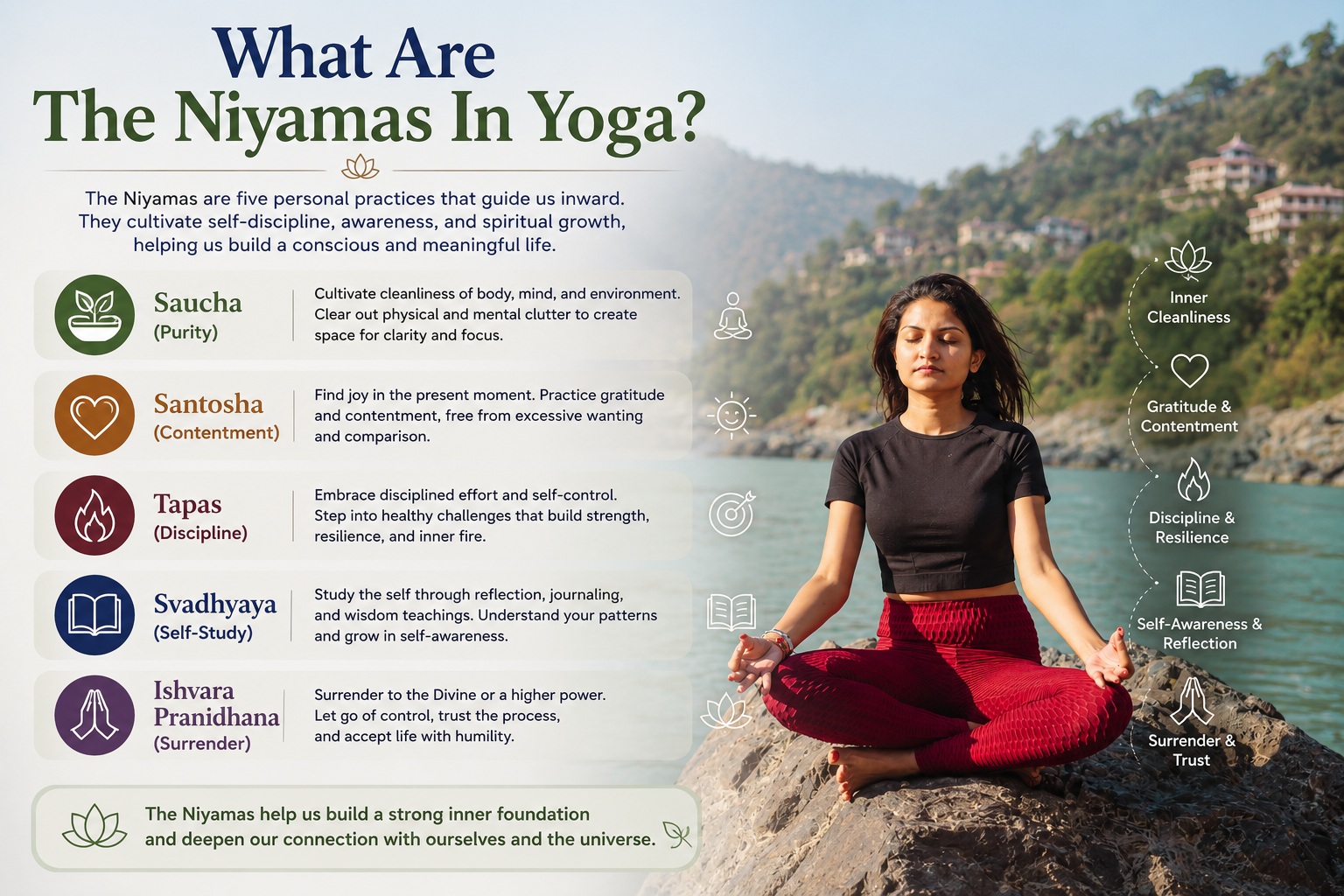
If the Yamas point outward, the Niyamas point in. The word "Niyama" means "observance" or "positive duty." These are five personal practices, habits of body and mind, that support your inner growth and your relationship with yourself.
Saucha means cleanliness or purity, and it applies on multiple levels. Physically, it includes things like hygiene, clean eating, and an orderly environment. But the more interesting dimension is mental Saucha, the ongoing practice of clearing out the mental clutter.
Clutter, both physical and psychological, has real effects on cognition. A landmark study from Princeton University's Neuroscience Institute found that visual clutter in the environment competes for neural resources, reducing the ability to focus and increasing stress.
A clean desk, a digital detox, a few minutes of quiet meditation - they're expressions of Saucha with measurable impact on how well your mind functions.
Santosha is sometimes the hardest Niyama to swallow in a culture built around wanting more. It means contentment, not passive resignation, but an active appreciation of what is, right now, without needing circumstances to be different before you can feel okay.
The hedonic treadmill is a concept from positive psychology that describes how humans quickly adapt to improved circumstances and return to a baseline level of happiness. New house, new salary, new relationship… after the initial boost, satisfaction reverts. Santosha is a kind of antidote to that. It's the practice of finding the floor of okayness beneath the constant flux of wanting.
Tapas literally translates as "heat" or "fire." In practice, it refers to the disciplined effort that burns away impurity and strengthens character.
This is not about punishment or deprivation. Tapas is the willingness to be uncomfortable in service of growth like waking up earlier than feels natural, sticking with a meditation practice through the restless days, returning to the breath when the mind bolts.
Research on self-regulation confirms what yogis have known for centuries: consistent small habits, practiced with intention, compound significantly over time.
Svadhyaya means self-study or self-inquiry. In the classical tradition, it included the study of sacred texts as a path to understanding the nature of the self. For modern practitioners, it tends to broaden into any form of honest reflection, journaling, therapy, meditation, reading philosophy and paying attention to your own patterns.
The essential question Svadhyaya asks is: who is doing all of this? What drives your reactions, your choices, your fears? Most of us go through large portions of life on autopilot, running scripts we absorbed in childhood without ever examining them.
Ishvara Pranidhana (Surrender)
The fifth Niyama is also the one most prone to misunderstanding. Ishvara Pranidhana means surrender to the divine, or surrender to a higher power. For practitioners who don't hold theistic beliefs, it's often translated more broadly as letting go of the ego's insistence on control.
In practical terms, it's recognizing that there are forces at work beyond your planning and willpower. You can put in the effort, act with integrity, and then, this is the hard part, release attachment to the specific outcome. It's the yoga of “I did my part.”
Psychologically, the inability to tolerate uncertainty is one of the primary drivers of anxiety. Ishvara Pranidhana is, in part, a practice of increasing what researchers call "distress tolerance" - the capacity to sit with not-knowing without it collapsing you.
Why Are The Yamas And Niyamas Important?
Patanjali talked about what are the Yamas and Niyamas before pranayama, before the physical postures (asana), before meditation. The ethics come first and that too on purpose.
- If your relationships are riddled with dishonesty, your mind full of resentment, and your habits chaotic, sitting on a cushion to meditate is going to be an uphill battle. The Yamas and Niyamas create the conditions in which the rest of the practice can actually take root.
- They also offer something increasingly rare: a framework for living that doesn't depend on external validation. You don't need likes, applause, or outcomes to practice Ahimsa or Santosha. The measuring stick is internal.
- For mental and emotional balance, these principles function almost like a map for the mind. Research across positive psychology, acceptance-based therapies, and contemplative neuroscience converges on similar themes: compassion, authenticity, moderation, self-awareness, and the capacity to let go are all independently associated with psychological wellbeing. The Yamas and Niyamas named all of these, in Sanskrit, roughly 1,600 years ago.
Students enrolled in a 300 Hour Yoga Teacher Training in Rishikesh often explore the deeper philosophical meaning of the Yamas and Niyamas and how they apply to modern life.
How To Practice Yamas And Niyamas In Daily Life
You don't need to be a devoted yogi or have a Sanskrit dictionary on your shelf. These practices are accessible anywhere, and they tend to compound quietly.
A few concrete entry points:
- Mindful communication: Before speaking, pause and run the thought through the filter of Ahimsa and Satya.
- Gratitude journaling: A simple daily practice of noting what you're genuinely grateful for activates Santosha and pulls attention away from the chronic dissatisfaction that runs in the background of most modern minds.
- Digital limits: Setting intentional boundaries on screen time is Brahmacharya in its most contemporary form. The average person spends over six hours per day on screens. Much of that is passive, draining consumption rather than anything that actually replenishes.
- Movement with intention: Any physical practice becomes Tapas when you show up consistently, even on the hard days, without needing it to be perfect.
- Journaling or therapy: Regular written or verbal self-reflection is Svadhyaya at its most practical.
- Decluttering: Going through your physical space with the lens of Saucha and Aparigraha is surprisingly therapeutic.
Yamas And Niyamas In Modern Life
It's worth acknowledging how much the modern environment runs counter to almost every one of these principles.
Social media is an Aparigraha trap, built around comparison and accumulation of followers, of status, of affirmation. The algorithmic feed is designed to keep you wanting. Brahmacharya would ask: how much of your energy goes here, and what does it give back?
Stress culture glorifies overwork and treats rest as laziness. Tapas gets misread as pushing harder instead of pushing smarter. Santosha - contentment with where you are, is practically subversive in a world that profits from your dissatisfaction.
Work-life balance is, at its core, a Brahmacharya question. Burnout has reached near-epidemic proportions: the World Health Organization officially recognized it as an occupational phenomenon in 2019, characterizing it by exhaustion, cynicism, and reduced efficacy.
The Yamas and Niyamas don't promise immunity from modern pressures. But they provide a vocabulary and a set of practices for navigating those pressures with more intention.
Common Misunderstandings About Yamas And Niyamas
A few things worth clearing up:
- They are not religious rules. While they emerge from Hindu philosophical tradition, the Yoga Sutras of Patanjali are not theology. They're closer to applied philosophy or psychology. You don't need to belong to any religion, hold any particular beliefs, or perform any rituals to benefit from them.
- They are not about perfection. This trips people up. The goal is not to never lose your temper, never cling to outcomes, never eat something less-than-pure. The goal is to become increasingly aware of when and why you do, so that your choices can become more conscious over time. Progress, not purity.
- They're not rigid commandments. The tradition acknowledges context. Ahimsa and Satya can sometimes conflict. What then? You use judgment. These are tools for thinking more clearly, not rules to follow mindlessly.
- They are for everyone. Patanjali specifically described the Yamas as "universal great vows" (mahavrata), applicable across time, place, class, and circumstance. You don't need to be a yoga teacher, a vegetarian, or someone who owns a mat.
Yamas vs Niyamas: What's The Difference?
| | Yamas | Niyamas |
| Focus | Others and the world | The self |
| Type | Social ethics | Personal disciplines |
| Direction | External behavior | Internal growth |
| Examples | Non-violence, truthfulness, non-stealing | Purity, contentment, self-study |
| Core question | How do I treat others? | How do I relate to myself? |
The simplest way to remember it: Yamas are about how you show up in the world, Niyamas are about how you build yourself from the inside.
To Sum it Up
The Yamas and Niyamas remind us that yoga is more than physical postures. Long before "yoga" became synonymous with a particular kind of fitness class, it was a comprehensive system for living, one that began not on the mat, but in the texture of daily choices, relationships, and inner life.
What's striking is how thoroughly modern science has caught up to what these principles have been pointing at for centuries. Compassion, authenticity, moderation, self-awareness, contentment, discipline, letting go… these aren't ancient superstitions. They're the building blocks of a life that actually holds together.