Chapter two of the Yoga Sutras of Patanjali is the Sadhana Pada takes us ahead by explaining how one might get into a yogic condition. This section contains 55 sutras explaining yoga as a discipline outlining its eight limbs of yoga or practical aspects.
Summary of Sadhana Pada
What Is Sadhana Pada?
The word Sadhana comes from Sanskrit and means "practice" or "discipline." Pada means "chapter" or "foot." Together, Sadhana Pada translates to the Chapter of Practice, a guide for those who are ready to walk the path of yoga with sincere effort and commitment.
If Samadhi Pada plants the seed of understanding, Sadhana Pada teaches you how to water it. It brings yoga down from the realm of philosophy and into daily life. This chapter speaks directly to the practitioner, someone who is willing to do the inner and outer work required to move toward liberation.
Why Chapter 2 Is Important in Patanjali Yoga Sutras
The Yoga Sutras of Patanjali are made up of four chapters. Each chapter addresses a different stage of the yogic journey. Chapter 2, Sadhana Pada, holds a particularly important place because it is where practice truly begins.
Patanjali understood that most of us are not ready to jump straight into deep states of meditation. Our minds are restless, our habits are deeply ingrained, and our understanding of the self is clouded by ignorance. Sadhana Pada addresses this reality head-on. It offers a practical and structured path for the sincere seeker.
This chapter introduces Kriya Yoga, the yoga of action, as a starting point. It then goes on to explain the five obstacles that block spiritual progress and, most importantly, presents the Eight Limbs of Yoga (Ashtanga Yoga). These eight limbs form one of the most complete frameworks for human development ever recorded. They cover everything from how we treat others to how we train the body, the breath, the senses, and the mind.
Difference Between Samadhi Pada and Sadhana Pada
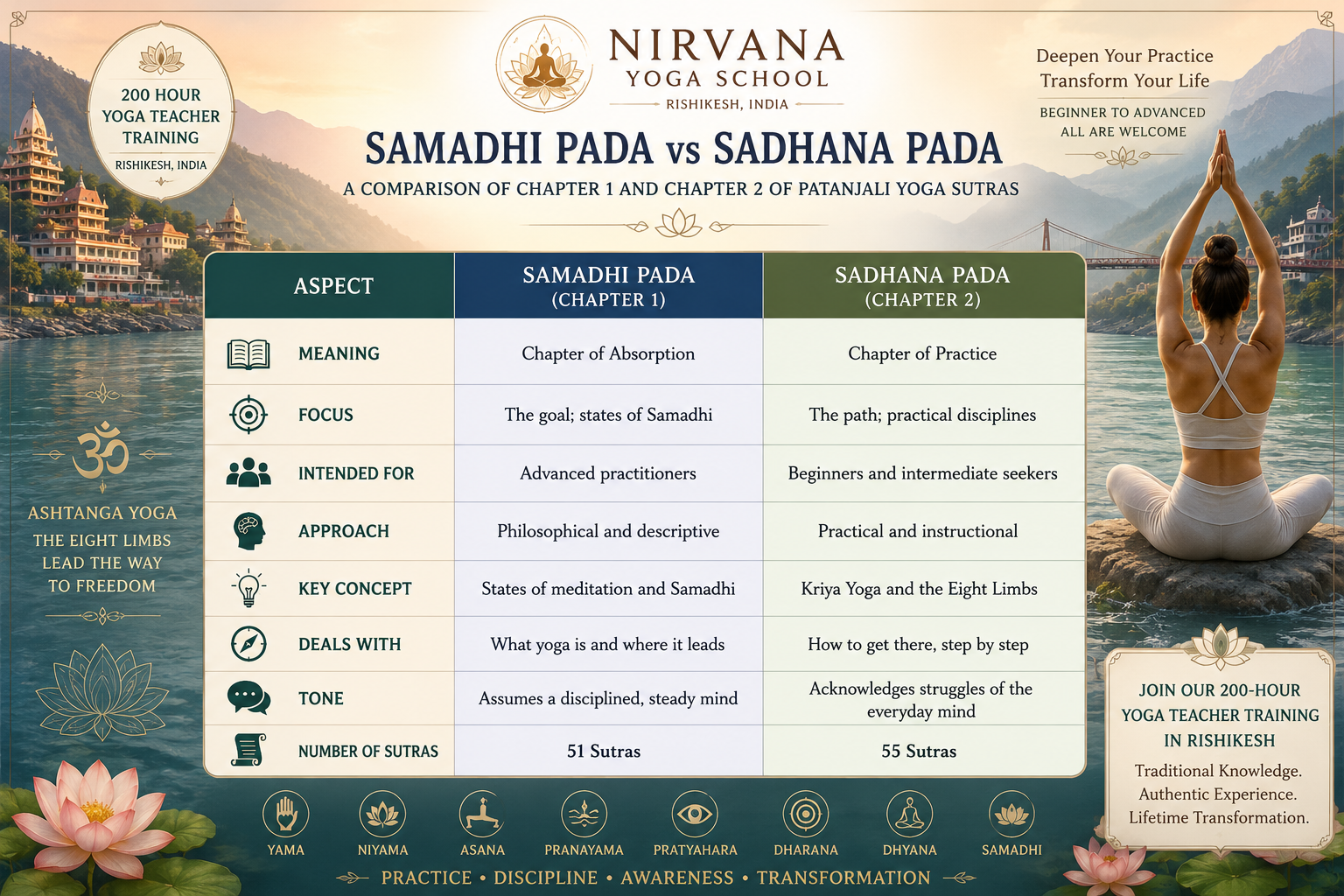
The Yoga Sutras open with Samadhi Pada, the Chapter of Absorption. It describes the highest states of yoga, what deep meditation looks like, what Samadhi is, and how the mind becomes completely still. It is written for those who are already well along the path.
Sadhana Pada begins from where most of us actually are. It acknowledges the struggles of the everyday mind and offers the tools to work through them step by step.
Here is how the two chapters differ:
| Aspect | Samadhi Pada (Chapter 1) | Sadhana Pada (Chapter 2) |
| Meaning | Chapter of Absorption | Chapter of Practice |
| Focus | The goal; states of Samadhi | The path; practical disciplines |
| Intended For | Advanced practitioners | Beginners and intermediate seekers |
| Approach | Philosophical and descriptive | Practical and instructional |
| Key Concept | States of meditation and Samadhi | Kriya Yoga and the Eight Limbs |
| Deals With | What yoga is and where it leads | How to get there, step by step |
| Tone | Assumes a disciplined, steady mind | Acknowledges struggles of the everyday mind |
| Number of Sutras | 51 Sutras | 55 Sutras |
What Is Kriya Yoga
Since Samadhi is so challenging, we must approach it carefully. Kriya-yoga is the preparatory stage. Kriya yoga means working towards yoga. One must practice austerity or tapas. One must be disciplined. The organs, mind, intellect, and body must be properly controlled by the self. To do this, one must study books that teach about liberating the soul. A yogi must only read to boost his judgments.
The two categories of scriptural knowledge are called Vada (the argumentative) and Siddhanta (the conclusive). When a guy is truly uninformed, he engages in the first two: reasoning and arguments. Then he moves on to Siddhanta to draw the judgment. Reaching this conclusion on its own is not enough. It needs to be more intense. Since there are an endless number of books and a limited amount of time, the key to knowing is to focus on what is essential.
After passing the argumentative condition the Yogi has now reached a decision that is unchangeable and is like the rocks. Now all that is left is to make that conclusion stronger. One must avoid arguing. Be silent if someone pushes an argument on one. As arguments disrupt the mind. The mind is a feeble tool that can only provide us with information that is restricted to our senses. Since the Yogi seeks to transcend the senses, intellect serves no purpose for him.
Surrendering the fruits of work to God means giving up both praise and blame to the lord and finding serenity in doing so.
Key Teachings of Sadhana Pada
Sadhana Pada is rich with practical wisdom. It does not ask you to simply believe in yoga, it asks you to live it. The chapter is built around four core teachings that work together to guide the practitioner from a state of inner confusion toward clarity, discipline, and eventually liberation.
Kriya Yoga: The Yoga of Action
Patanjali begins Sadhana Pada with Kriya Yoga, and for good reason. Before one can sit in deep meditation, the ground must be prepared. Kriya Yoga is that preparation.
It rests on three pillars:
- Tapas - austerity and self-discipline. This means training the body and mind to endure discomfort without complaint. It is about building the inner strength to stay steady when life is difficult.
- Svadhyaya - self-study. This includes the study of sacred texts as well as the honest observation of one's own thoughts, habits, and patterns. A yogi reads not to accumulate knowledge, but to sharpen his understanding of the self.
- Ishvara Pranidhana - surrender to God. All actions are offered to the divine. The practitioner stops clinging to results and learns to act without ego. This surrender brings a deep and lasting peace.
Together, these three form the foundation for everything that follows in Sadhana Pada. Without Kriya Yoga, the higher limbs of yoga remain out of reach.
Kleshas: The Five Obstacles
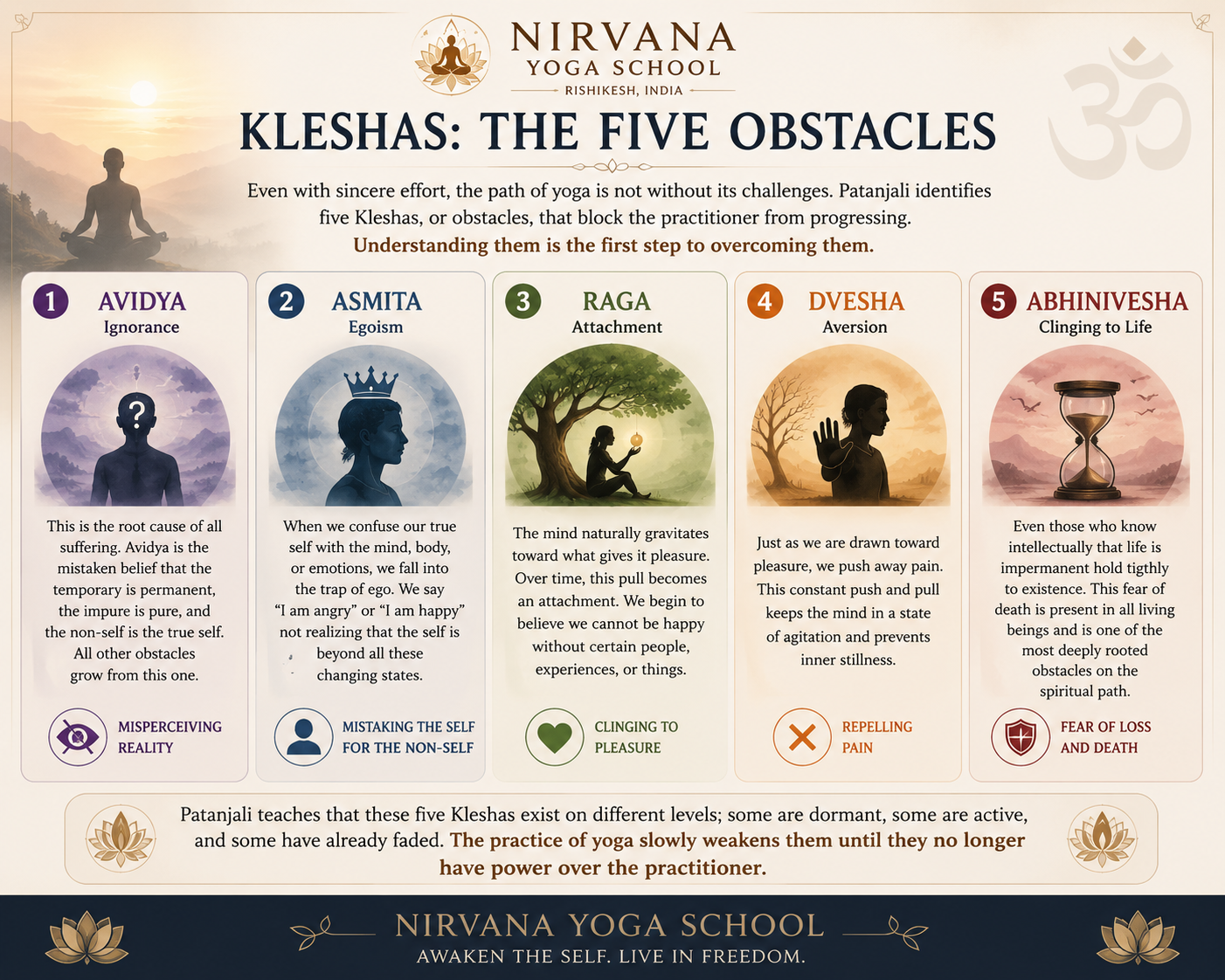
Even with sincere effort, the path of yoga is not without its challenges. Patanjali identifies five Kleshas, or obstacles, that block the practitioner from progressing. Understanding them is the first step to overcoming them.
- Avidya - Ignorance. This is the root cause of all suffering. Avidya is the mistaken belief that the temporary is permanent, the impure is pure, and the non-self is the true self. All other obstacles grow from this one.
- Asmita - Egoism. When we confuse our true self with the mind, body, or emotions, we fall into the trap of ego. We say "I am angry" or "I am happy" not realizing that the self is beyond all these changing states.
- Raga - Attachment. The mind naturally gravitates toward what gives it pleasure. Over time, this pull becomes an attachment. We begin to believe we cannot be happy without certain people, experiences, or things.
- Dvesha - Aversion. Just as we are drawn toward pleasure, we push away pain. This constant push and pull keeps the mind in a state of agitation and prevents inner stillness.
- Abhinivesha - Clinging to life. Even those who know intellectually that life is impermanent hold tightly to existence. This fear of death is present in all living beings and is one of the most deeply rooted obstacles on the spiritual path.
Patanjali teaches that these five Kleshas exist on different levels; some are dormant, some are active, and some have already faded. The practice of yoga slowly weakens them until they no longer have power over the practitioner.
How Kleshas Affect Daily Life
Most people go through life without realizing that their suffering has a pattern. They feel stressed, anxious, attached, or afraid, and they look for external reasons to explain it. Patanjali, however, points to something much deeper. He teaches that the root of all human suffering lies in the five Kleshas.
1. Stress and Anxiety - At the heart of most stress is Avidya, ignorance. We stress because we believe things must go a certain way. We worry because we are convinced that our happiness depends on a particular outcome. When reality does not match our expectations, the mind spirals.
Raga and Dvesha feed this cycle further. We are constantly chasing what we want and running from what we do not want. This endless push and pull keeps the nervous system on edge. The mind never truly rests because it is always either grasping or resisting.
Patanjali teaches that stress is not caused by circumstances; it is caused by the way the mind relates to circumstances.
2. Emotional Attachments - Raga, the Klesha of attachment, is perhaps the most familiar one in daily life. We become attached to people, relationships, routines, comfort, and even our own emotions. There is nothing wrong with love or connection. The problem arises when attachment turns into dependency, when we believe we cannot be at peace without a specific person or situation remaining exactly as it is.
Asmita, or egoism, deepens this further. When we identify so strongly with our relationships and roles, as a parent, a partner, a professional, we lose sight of who we truly are beneath all of these labels. Any threat to these identities feels like a threat to our very existence. This is why the loss of a relationship or a job can feel so devastating. It is not just a loss of something external. It feels like a loss of the self.
Yoga does not ask us to stop caring. It asks us to love without clinging, to be fully present in our relationships without making them the source of our sense of self.
3. Fear and Insecurity - Abhinivesha, the Klesha of clinging to life, is the source of our deepest fears. It is the fear of loss, the fear of change, and ultimately the fear of death. This fear is so fundamental that it operates even in people who have studied philosophy and know intellectually that life is impermanent.
This Klesha shows up in subtle ways too. The fear of failure, the fear of rejection, the fear of not being enough, all of these trace back to the same root. We are clinging to a version of life, or a version of ourselves, that we do not want to lose.
Avidya sits underneath all of it. Because we do not truly know the self, we look for security in things that are temporary - status, approval, certainty, control. When any of these are threatened, insecurity follows immediately.
Sadhana teaches us to find our security not in the external world, but in the steadiness of our own inner practice. The more rooted we become in our true nature, the less power fear has over us.
4. Ego and Self-Identity - Asmita is the Klesha of egoism. It is the mistaken identification of the self with the mind, body, and intellect. In daily life, this shows up as the constant need to protect and project a certain image of ourselves.
We want to be seen as capable, successful, kind, or spiritual. When someone challenges that image, through criticism, disagreement, or simply by not responding the way we hoped, the ego reacts. It defends, justifies, or withdraws.
The ego is also responsible for comparison and competition. We measure ourselves against others and feel either superior or inadequate depending on the result. Neither feeling brings lasting peace.
Patanjali does not ask us to destroy the ego. He asks us to see it clearly. When we recognize Asmita at work in our thoughts and reactions, we create a small but powerful distance between the observer and the observed. That distance is where freedom begins.
Spiritual Discipline: The 8 Limbs of Yoga
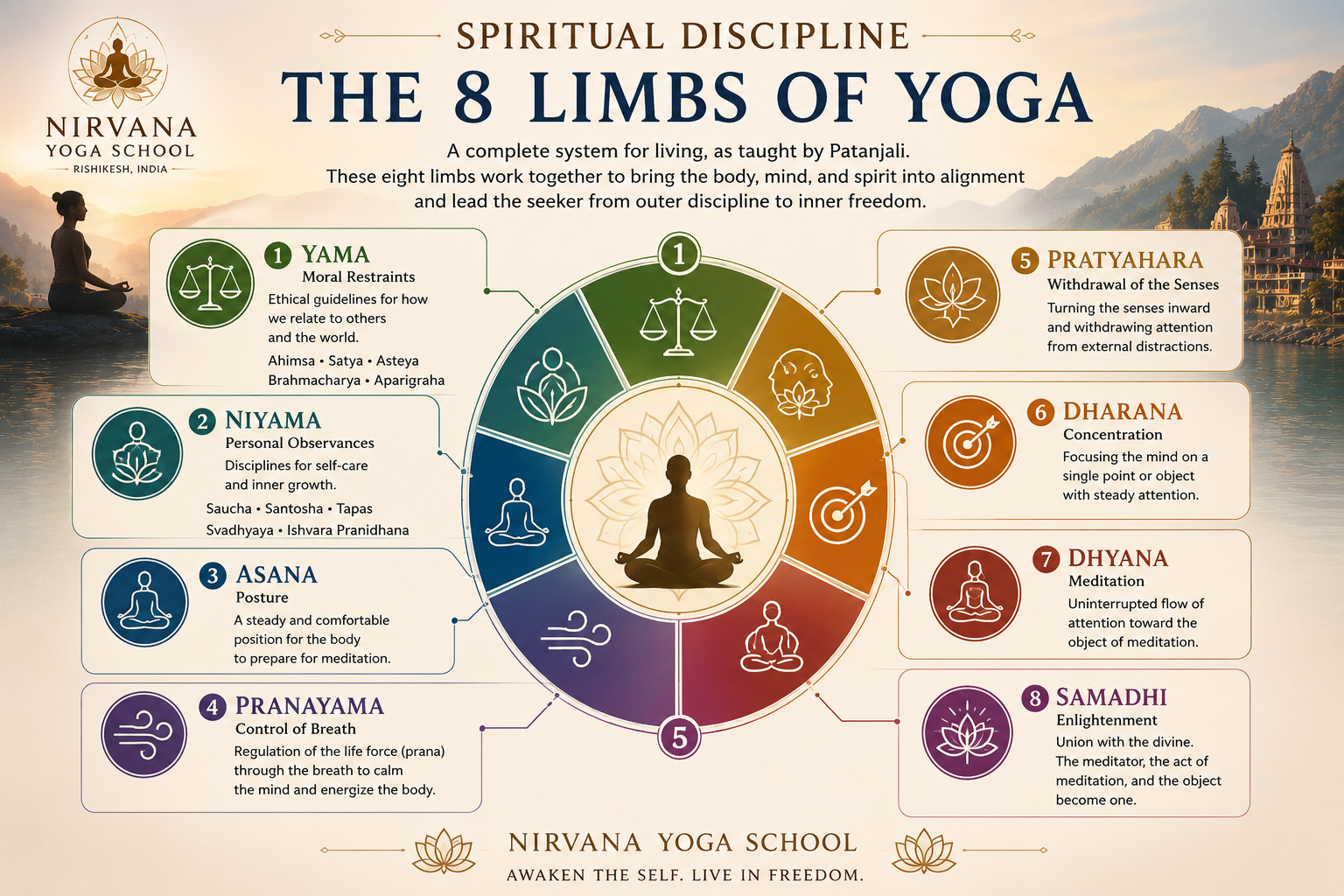
Yoga is not only a practice for the body. It is a complete system for living. Patanjali presents the Eight Limbs of Yoga as a path available to every sincere seeker, regardless of caste, background, or belief. These eight disciplines work together to bring the body, mind, and spirit into alignment.
Here are the 8 limbs at a glance:
| Limb | Sanskrit | Meaning |
| 1 | Yama | Moral restraints |
| 2 | Niyama | Personal observances |
| 3 | Asana | Posture |
| 4 | Pranayama | Control of breath |
| 5 | Pratyahara | Withdrawal of the senses |
| 6 | Dharana | Concentration |
| 7 | Dhyana | Meditation |
| 8 | Samadhi | Enlightenment |
1. Yama - Five Moral Restraints
The journey begins with how we live and relate to others. The five Yamas are ethical guidelines for our conduct in the world.
- Ahimsa: Non-violence in thought, word, and action
- Satya: Truthfulness, spoken with kindness and compassion
- Asteya: Non-stealing; taking only what we truly need
- Brahmacharya: Continence and purity in speech, thought, and conduct
- Aparigraha: Non-possessiveness; freedom from attachment to material things
Our goal is to live in a way that causes no harm to any living being. We must recognize the same divine self, the Atman, in every person we meet. This does not mean we accept or support wrongdoing. It simply means we act from a place of compassion rather than selfishness.
It is important to remember that nothing in this world truly belongs to us. We are only stewards of what we have. When we take more than we need and waste it, we are in a sense stealing from the rest of humanity.
2. Niyama - Five Personal Observances
Where the Yamas govern how we relate to the outer world, the Niyamas govern how we relate to ourselves. They are the disciplines of inner life.
- Saucha: Purity of body and mind
- Santosha: Contentment with one's circumstances
- Tapas: Austerity and self-discipline
- Svadhyaya: Self-study and the study of sacred texts
- Ishvara Pranidhana: Surrender to God
To be pure is to be clean inside and out. A healthy diet purifies the body. A healthy mental diet purifies the mind. This means being mindful of what we read, how we speak, and how much we consume. Gossip, idle talk, and meaningless entertainment slowly cloud the mind and create habits that are difficult to break.
Contentment means accepting one's place in life without envy or restlessness.
Surrendering to God is the highest of the Niyamas. When all actions are offered to the divine and the fruits of those actions are released, the practitioner finds a peace that no external circumstance can disturb.
Patanjali recognizes four great paths to union with God:
- Bhakti Yoga - The path of devotion. God is approached through prayer, worship, chanting, and japam. It is the cultivation of a deep, sincere, and personal relationship with the divine. For those naturally inclined toward love and devotion, this is the most accessible path.
- Karma Yoga - The path of selfless action. Every action is dedicated to God and performed without attachment to results. This practice gradually dissolves the ego and brings wisdom and non-attachment. As Sri Krishna teaches Arjuna in the Bhagavad Gita, it is not the action itself but the spirit in which it is done that determines its spiritual value.
- Jnana Yoga - The path of wisdom. Through deep inquiry, discrimination, and analysis, the practitioner seeks to understand the true nature of reality and the self. This is a demanding path that requires extraordinary clarity and willpower.
- Raja Yoga - The path of meditation. Often called the royal path, Raja Yoga works with the body as a channel for spiritual energy. It explores the nature and function of the mind and leads the practitioner inward through systematic meditation.
These four paths are not separate or competing. They support one another. A sincere spiritual life cannot be lived without love, right action, wisdom, and inner stillness. Patanjali teaches that regardless of the path one follows, the Eight Limbs of Yoga remain the essential framework.
3. Asana - Posture
Before the mind can be trained, the body must be steady. Asana means finding a position that is both stable and comfortable, one that can be held for extended periods without strain or distraction.
When the body is restless or in pain, the mind cannot settle. When the body is calm and still, the mind has the conditions it needs to turn inward. This is the true purpose of Asana in the yogic tradition.
4. Pranayama - Control of Breath
Once the body is steady, attention moves to the breath. Pranayama is the regulation of prana, the vital life force that flows through the body. The breath is the most direct bridge between the body and the mind.
Pranayama works through three phases: inhalation, exhalation, and retention. Through disciplined practice, prana can be directed to specific parts of the body and held there for a period of time. Over time, this practice awakens the Kundalini, the dormant spiritual energy that lies at the base of the spine.
At advanced stages of practice, the breath may naturally become very slow or even momentarily still during deep concentration. This is not forced. It is a natural result of the mind becoming profoundly quiet.
5. Pratyahara - Withdrawal of the Senses
The senses are constantly pulling the mind outward - toward sound, sight, smell, taste, and touch. Pratyahara is the practice of withdrawing the senses from their objects and turning attention inward.
When the covering of ignorance begins to lift, the practitioner starts to perceive an inner light. Mastery over the five senses gradually follows. When the senses are no longer in control, the yogi gains mastery over feelings, reactions, and actions.
With Pratyahara established, the mind is finally prepared for the deeper practices of concentration and meditation.
6. Dharana - Concentration
With the senses withdrawn, the mind learns to fix itself on a single point. This is the beginning of meditation, the ability to hold the attention steady without wandering.
7. Dhyana - Meditation
When concentration deepens and becomes uninterrupted, it becomes meditation. There is no longer any effort to focus, the mind simply rests in a continuous, undisturbed flow of awareness.
8. Samadhi - Absorption
The final limb. In Samadhi, the meditator, the act of meditation, and the object of meditation become one. The ego dissolves and pure consciousness alone remains.
Practical Lessons from Sadhana Pada
Sadhana Pada is not meant to be read and set aside. It is meant to be lived. Here are the key lessons every practitioner can take from this chapter into daily life.
Develop Self-Discipline
Progress on the yogic path does not come from enthusiasm alone, it comes from consistency. Tapas asks us to show up to practice even when the mind resists. Small, daily acts of discipline build the inner strength that no single intense effort can create. Wake up at the same time. Sit in practice every day. Keep your word to yourself.
Control the Mind
The mind left unattended will wander toward comfort, distraction, and habit. Sadhana Pada teaches that mental control is not suppression; it is direction. Through pranayama, pratyahara, and steady practice, the practitioner gradually learns to choose where attention goes rather than being pulled by every thought and impulse.
Practice Non-Attachment
Raga, attachment, is one of the five Kleshas for a reason. Clinging to outcomes, people, and comfort is a direct source of suffering. Non-attachment does not mean indifference. It means doing your best and releasing the result.
Follow the Eight Limbs
The Eight Limbs are a way of life. Begin with the Yamas and Niyamas. Let ethical living and inner discipline form the ground beneath your practice. Build from there. Asana steadies the body. Pranayama steadies the breath. The rest follows naturally with time and sincerity.
Cultivate Self-Awareness
Svadhyaya, self-study, is one of the most powerful tools in Sadhana Pada. Watch your reactions. Notice your patterns. Ask yourself which Klesha is driving a particular thought or behavior. The practitioner who knows themselves clearly has already taken a significant step toward freedom.