My grandmother used to sing to a small brass photo frame every morning before she did anything else — before tea, before the news, before any of us were even awake. I didn't understand it as a child. I do now. That quiet, daily act of love directed at something larger than herself is, at its heart, what Bhakti Yoga is. Bhakti Yoga is the path of devotion — one of yoga's oldest branches,rooted in devotion, love,adoration,and submitting your soul to god and daily practice rather than performance.Maybe that's why millions of people still walk this path today. You don't need perfect flexibility . If your heart can love, you already have what this path asks for. You just need to feel something, and be willing to point that feeling somewhere meaningful.
Whether you're new to Bhakti Marga or want to explore Bhakti Yoga, this guide explains its meaning, nine forms, benefits, and simple ways to practice devotion in daily life.
What is Bhakti Yoga?
"Bhakti comes from the Sanskrit root bhaj, meaning 'to share,' 'to adore,' 'to worship,' or 'to serve.' Over time, the word came to mean loving devotion toward the Divine."Krishna describes the idea l devotee this way in the Bhagavad Gita:
From the Bhagavad Gita (Krishna to Arjuna, Chapter Paraphrased 12.2:
"Those who fix their mind on me and only I dwell in their thoughts; and who sing my glories with love and devotion; and who have complete faith in me are the best."
In short: the "best" yogi is not the most disciplined — it's the one whose heart stays with the divine,no matter what.
Bhakti Yoga is really just loving the divine on purpose, every day, until it becomes part of your daily life .It's one of three classical paths in yogic philosophy. People assume "yoga" means stretching. It didn't originally. Yoga comes from yuj, yuj means "to unite." For beginners, Bhakti Yoga is simply the path of union through love.It's the kind you carry with you, not the kind you practice on a mat.For beginners, Bhakti Yoga is understood as: loving someone so much, so consistently, that the love itself becomes the practice.
History of Bhakti Yoga
We understand ‘yoga’ as a fitness routine, it meant connection — and Bhakti was one of the earliest forms that connection took.Bhakti isn't a modern term, it's genuinely ancient.The word first appears in the Shvetashvatara Upanishad, where it means heartfelt devotion.People were living it long before it was called a spiritual path.In the Bhagavad Gita, Krishna presents Bhakti as a complete path to moksha, alongside Jnana Yoga and Karma Yoga.By Chapter 12, though, he's not even hiding it, devotion is the one he calls easiest to walk.
Between the 7th and 17th centuries, the Bhakti movement spread across India, beginning in Tamil Nadu. What made it powerful wasn't just the songs and poetry — it was the message hidden under them: you don't need permission, status, or Sanskrit to love God.It challenged the belief that only priests and scholars could reach God. For the first time, Devotion became something that anyone could experience, Poet-saints like Mirabai, Kabir, Tulsidas, and Chaitanya Mahaprabhu each expressed devotion in their own way, through songs, poetry, storytelling, and kirtan—bringing spirituality closer to ordinary people.Their message was simple:devotion was for everyone, not just scholars or priests.That spirit remains at the heart of the Bhakti path today.
Philosophy of Bhakti Yoga
You can chant a thousand mantras and still miss the point if your heart isn't in it. Love matters more than form, a prayer spoken with real feeling means more than a perfect one said without thinking. Surrender to the god doesn't mean giving up; it means letting go of the need to control every outcome, doing your part, and trusting the rest. Real bhakti doesn't come with a price tag. The moment it expects something in return, it stops being devotion and becomes a transaction. Bhakti seeks peace of mind, not money. Above all, it encourages a personal relationship with God—as a parent, a friend, or a beloved. Mirabai loved Krishna like a husband, while Hanuman served Rama with unwavering devotion. The form may change, but bhakti reminds us that the Divine is someone we can truly relate to, not just worship from afar.
Core Principles of Bhakti Yoga
Faith (Shraddha)
Faith isn't blind belief it's more like trust you build over time. You keep showing up, even on the days it feels like nothing's happening, because something in you knows it matters anyway.
Love (Prema)
This is the engine of the whole thing. Not romantic love, not even "I love you" in the casual sense closer to the kind of love where you stop counting what it costs you.
Devotion (Bhakti)
Devotion is what happens when that love gets repeated, day after day, until it's no longer a feeling you have, sometimes it's just who you are.
Surrender (Sharanagati)
This one's quietly the hardest. Surrender means putting down the need to control how things turn out. You show up, you do your part, and then you actually let go not just say you did.
Compassion
You can't really love the divine and stay cold toward people. Bhakti has a way of softening you once your heart opens for God, it tends to open for everyone else too.
Humility
The more real your devotion gets, the smaller your ego usually gets with it. Real bhaktas aren't the loudest people in the room; they're often the quietest, because they're not performing for anyone.
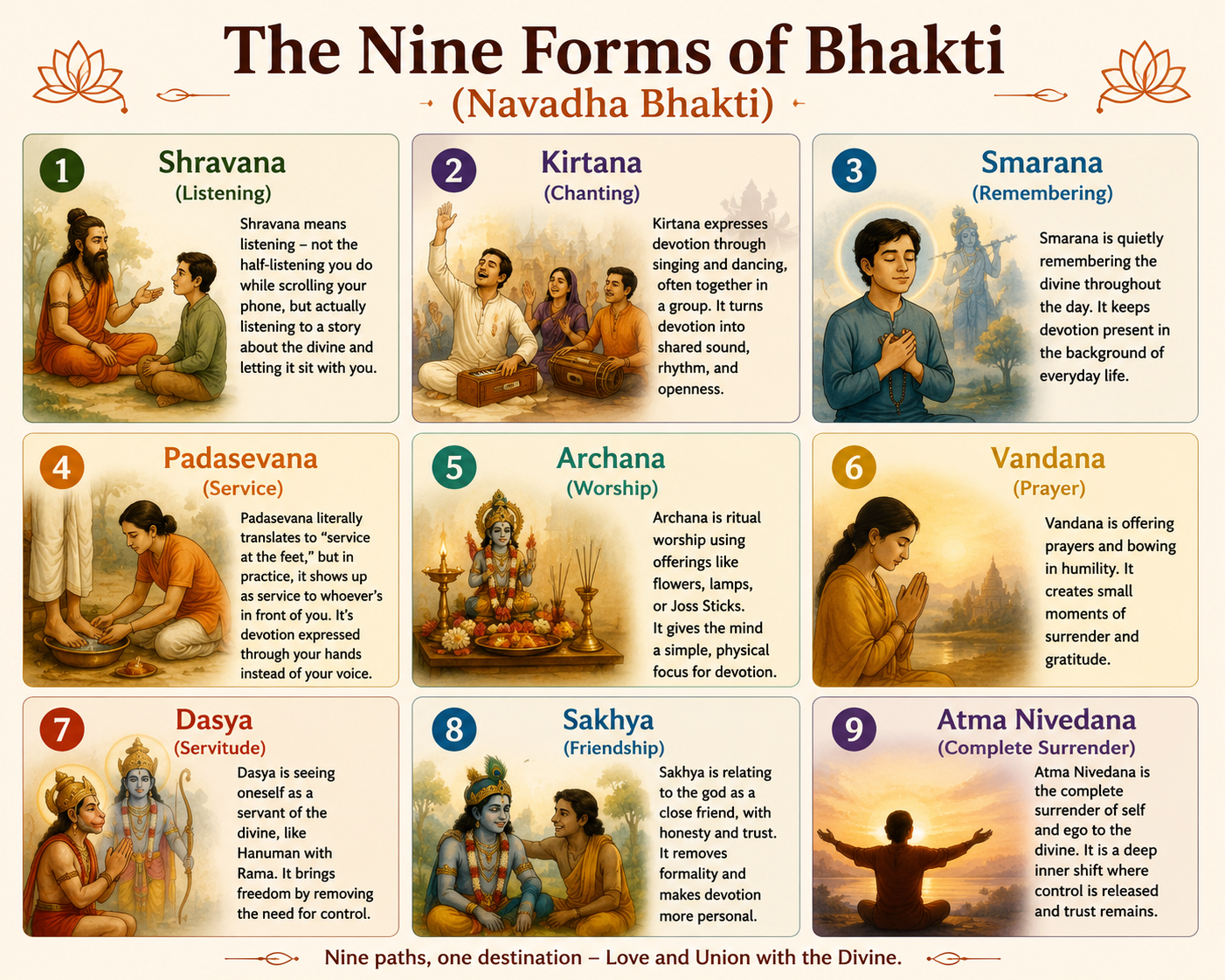
The Nine Forms of Bhakti (Navadha Bhakti)
Shravana (Listening)
Shravana means listening not the half-listening you do while scrolling your phone, but actually listening to a story about the divine and letting it sit with you.
Kirtana (Chanting)
Kirtana expresses devotion through singing and dancing,often together in a group. It turns devotion into shared sound, rhythm, and openness.
Smarana (Remembering)
Smarana is quietly remembering the divine throughout the day. It keeps devotion present in the background of everyday life.
Padasevana (Service)
Padasevana literally translates to "service at the feet," but in practice, it shows up as service to whoever's in front of you. It's devotion expressed through your hands instead of your voice.
Archana (Worship)
Archana is ritual worship using offerings like flowers, lamps, or Joss Sticks.It gives the mind a simple, physical focus for devotion.
Vandana (Prayer)
Vandana is offering prayers and bowing in humility. It creates small moments of surrender and gratitude.
Dasya (Servitude)
Dasya is seeing oneself as a servant of the divine, like Hanuman with Rama. It brings freedom by removing the need for control.
Sakhya (Friendship)
Sakhya is related to the god as a close friend, with honesty and trust. It removes formality and makes devotion more personal.
Atma Nivedana (Complete Surrender)
Atma Nivedana is the complete surrender of self and ego to the divine. It is a deep inner shift where control is released and trust remains.
How to Practice Bhakti Yoga Daily
You don’t require a special room to practice, just an hour. It’s less about adding new tasks to your day and more about noticing the divine in what you’re already doing.
Morning Routine
Before your phone or coffee, give yourself thirty seconds of quiet. Just remember you’re awake for another day and that it matters. Everything else flows easier once that’s in place.
Prayer
Skip formal language if it feels stiff. Talk like you would to someone who already knows you well—ask what you need, say what you’re grateful for and just sit, honestly if that’s all you’ve got.
Mantra Chanting
One name, repeated quietly while you do chores. It feels small, but there’s a reason this practice has lasted thousands of years: repetition does what thinking alone can’t.
Meditation
Forget sitting still for an hour. Two minutes with your eyes closed, attention resting gently on the divine rather than your inbox, is enough. Consistency beats duration here.
Reading Scriptures
Read slowly, not a lot. A few lines from the Gita, read with attention, will do more than ten chapters. Let it land before moving on.
Serving Others
This is devotion with your hands. Help someone, cook for someone, show up when it’s inconvenient.The point isn’t to be seen.
Gratitude Practice
At the end of the day, name two things that went right. Say it out loud, write it down, whatever sticks. It quietly changes how you remember your days.
Temple Visits
Go when you can, freely,but because sometimes you need a space built entirely for this—where devotion isn’t explained, just understood.
Benefits of Bhakti Yoga
Physical Benefits
Devotion isn’t a workout, but it affects the body through mental peace. Chanting, slows breathing, and meditation reduces the daily tension we carry. Regular practice often improves sleep not magically, but because a calmer mind creates a calmer body. It also builds discipline.
Mental Benefits
A mind chasing approval, results, or control gets exhausted. Bhakti gives it a place to rest. Repeating a name, listening to stories, or practicing gratitude pulls attention away from mental noise, slowly creating a quieter mind.
Emotional Benefits
Bhakti softens loneliness by giving emotions somewhere to go instead of being held alone. Fear, grief, and joy can be offered instead of suppressed. People often feel less reactive—not because life changes, but because they don’t carry everything inside.
Spiritual Benefits
This is harder to describe. It’s not sudden enlightenment, but a gradual sense of not being alone. Something feels present even without visible change. Over time, Bhakti reduces the feeling of doing everything by yourself and builds quiet inner trust.
Bhakti Yoga vs Karma Yoga
Both paths agree on one thing : stop being so obsessed with yourself. They just go about it differently. One disciplines the ego through duty. The other just tries to dissolve it through love. Here is the table showing major differences:
| Basis of differentiation | Bhakti Yoga | Karma Yoga |
| Core idea | Devotion and love for the divine | Selfless action without attachment to results |
| Main tool | The heart | The hands |
| What you let go of | Distance from God | Attachment to outcomes |
| Feels like | Falling in love, repeatedly | Doing your duty, without keeping score |
| Best suited for | People who connect through emotion | People who connect through doing |
Bhakti Yoga vs Jnana Yoga
Jnana Yoga is the harder, colder path. It asks you to question everything—who you are, what’s real, and what’s illusion—until intellectual clarity dissolves the ego. It suits those who trust the mind more than the heart.Bhakti takes the opposite route. Instead of breaking the self through logic, it dissolves it through love. Both lead to the same place—less ego, more truth—but by different paths. In the Gita, Krishna acknowledges the intellectual path but notes how difficult it is for most people. Bhakti is more forgiving of an ordinary, distracted mind.
Bhakti Yoga vs Raja Yoga
Raja Yoga is structured and disciplined—meditation, breath control, and mental focus through Patanjali’s eight-limbed system. It is training the mind like an athlete trains the body.Bhakti doesn’t rely on strict technique. There’s no fixed ladder—sincere love is enough. Raja Yoga builds control; Bhakti builds surrender.
Bhakti Yoga vs Hatha Yoga
Hatha Yoga is what most people think of as “yoga”, physical postures and breath work that steady the body and mind.Bhakti skips the body and goes straight to the heart. No flexibility or physical ability is required, which is why it has remained so universally accessible.
Bhakti Yoga in the Bhagavad Gita
Teachings
Chapter 12 of the Gita is short, just 20 verses but deeply meaningful. Arjuna asks whether it's better to love God as a personal being or meditate on the formless. Krishna says both paths lead to the same goal, but devotion is the gentler and more accessible path for most people.
Key Verses
Krishna calls those who worship him with steady faith the highest yogis. In verses 13–14, he describes a true devotee as someone free from hatred, kind, calm, and emotionally balanced. He also offers a practical path: if you can't meditate steadily, then practice; if that's difficult, simply act selflessly in his name.
Lord Krishna's Message
Krishna's message is simple: you don't need to be perfect or impressive to reach him. No special rituals or spiritual credentials are required—just sincere, steady love, offered again and again, is enough.
Best Mantras for Bhakti Yoga
Om Namah Shivaya
Is likely the best-known mantra in the world, Om Namah Shivaya means "I bow to Shiva," also honoring the divine within everything. It's widely used for grounding and calming the mind, making it a favorite for beginners.
Hare Krishna Maha Mantra
Hare Krishna, Hare Krishna, Krishna Krishna, Hare Hare. Hare Rama, Hare Rama, Rama Rama, Hare Hare. Popularized by Chaitanya Mahaprabhu, this mantra calls on Krishna and Rama with love and devotion. Rather than simply calming the mind, it's often described as bringing joy, especially when chanted in groups.
Om Namo Narayanaya
This mantra is a prayer to Narayana (Vishnu), the preserver. It carries a sense of protection and surrender, making it especially meaningful during difficult times when people want to let go of worry and place their trust in something greater.
Gayatri Mantra
Traditionally recited at sunrise, Gayatri Mantra is an ancient prayer for wisdom and inner light. Traditionally chanted at sunrise, it's meant to awaken the mind, bring clarity, and help begin the day with focus and intention.
Best Books on Bhakti Yoga
Bhagavad Gita
If you read just one book, make it the Bhagavad Gita. Chapter 12 is the heart of Bhakti Yoga, where Krishna explains the path of devotion in a practical and deeply personal way. A translation with commentary is helpful for beginners.
Narada Bhakti Sutras
The Narada Bhakti Sutras explain devotion through brief, powerful insights. It's one of the clearest texts for understanding the essence of Bhakti Yoga.
Srimad Bhagavatam
Rich with stories and teachings, the Srimad Bhagavatam brings Bhakti Yoga to life. The nine forms of bhakti are described here through the teachings of Prahlada, making devotion easy to understand through real examples.
Bhakti Yoga by Swami Vivekananda
Written for modern readers, this book presents Bhakti Yoga in a clear and practical way. Swami Vivekananda explains both the power of devotion and the importance of balancing it with wisdom.
Common Mistakes Beginners Make
- Expecting instant spiritual experiences: Bhakti usually grows slowly. Don't expect furious changes after just a few chants.
- Irregular practice: A few minutes every day is more effective than practicing only once in a while.
- Ignoring meditation: Sitting quietly after chanting helps the practice settle and deepen.
- Practicing without guidance: Learning from an experienced teacher can prevent confusion and keep you on the right path.
- Attachment to results: Don't measure your progress. Bhakti works best when practiced without expectations.
Tips to Deepen Your Bhakti Practice
- Practice daily: Even five sincere minutes each day can make a lasting difference.
- Stay consistent: Keep showing up, even when it feels like nothing is happening.
- Find a teacher: Guidance from someone experienced can make your journey much smoother.
- Join a satsang: Practicing with others brings inspiration and strengthens devotion.
- Practice gratitude: Begin with appreciation before asking for anything.
- Serve others: Let your devotion show through kindness and selfless actions.
Who Should Practice Bhakti Yoga?
- Beginners: One of the easiest ways to begin yoga—no experience required.
- Yoga teachers: Adds the devotional side that complements physical practice.
- Meditators: Brings warmth and connection to silent meditation.
- Spiritual seekers: Ideal for those looking for a deeper sense of purpose and devotion.
- Working professionals: Just a few minutes of daily practice can help reduce stress and bring balance.
- Retired individuals: A meaningful way to spend time while cultivating inner peace and devotion..
Final Thoughts
At the end of the day, Bhakti Yoga isn't complicated. It's just love, devotion that we express through different modes. We have practice again and again until it becomes part of who we are. There is no age in this whenever you feel it you start it .So start small. Say a quiet prayer in the morning. Chant a mantra while you're stuck in traffic. Help someone without expecting anything back. Nobody is perfect, all you need is just to be honest. The rest devotion trends grow on its own, slowly, the way real devotion always does.